Once, when our kids were young, I found myself sitting on the grass in front of a grocery store while the oldest had a full-on meltdown.
We'd stopped in for a few things. They wanted to ride in the shopping cart shaped like a race car, the red and yellow plastic one with the steering wheel bolted on the front.
I said no. We were short on time, and I just needed the little handheld basket.
That was all it took for the situation to devolve into sobs and wailing, right there in the store with people walking by and looking at us.
I carried both kids out, one in each arm, and sat down on the grass to figure out what to do next.
If you've ever had a child meltdown in a public place (or anywhere, really) you know exactly how that feels. The racing heart, the “what am I supposed to do here” panic, the sense that everyone is judging your parenting in real time.
Here's the truth I've learned after years of coaching families through this exact moment: managing meltdowns isn't about making them stop. It's about knowing what to do while it’s happening, and what to do afterward, so the relationship gets stronger instead of more strained.
Most of what's written about managing meltdowns focuses on your child: their triggers, their sensory needs, their coping skills. All of that matters, and we'll get into it. But the one piece that's fully in your control, especially in the middle of the actual moment, is what's happening in you.
That's what this post is about. We'll walk through what's actually happening in your child's brain and body during a meltdown, then give you four concrete steps for handling that moment as it unfolds, starting with the one part of the equation you can always work with: yourself.
What's Really Happening When Your Child Melts Down
Before we get to the steps, it helps to understand what a meltdown actually is. This context changes everything about how you respond.
Meltdown, Tantrum, Big Feelings… What Is It?
Lots of parents use “tantrum” and “meltdown” interchangeably, if you want to tease out the difference that’s fine because in our experience, in the “heat of the moment” it doesn't matter what you call it, the steps to get through it are the same.
According to Understood.org, meltdowns are a full-body reaction to feeling overwhelmed, and kids genuinely aren't in control of them. A meltdown can be explosive (crying, yelling, hitting) or it can be an implosion (quieter and more internal, like shutting down, going silent, or refusing to speak).
Common triggers include sensory overload (too much noise, light, or crowding), unexpected changes to a routine, exhaustion, or hunger. Sometimes it's a mix of several of these at once, on top of a disappointment that would have been manageable on a calmer day.
A meltdown is a sign that your child is overwhelmed and doesn't yet have the tools to handle it any other way.
The Brain Science Behind Managing Meltdowns
Here's the part that changed how I parent. Meltdowns are a completely normal part of child development, not a sign that something has gone wrong with your child, or with you.
Young children's brains are still building the wiring for self-regulation, the ability to notice a big feeling, pause, and choose a response instead of just reacting. The wiring for impulse control, calming, and perspective taking is centered in the prefrontal cortex, and it isn't fully developed until well into a person's twenties.
That's true whether the meltdown is triggered by disappointment, sensory overload, or an unexpected change to the plan. In every case, your child's system is genuinely overwhelmed, not choosing to give you a hard time.
According to the Center on the Developing Child at Harvard University, these self-regulation and executive function skills develop gradually from infancy through adolescence, and adult support at each stage is what actually builds your child’s capacity, not consequences or willpower. In other words, your child's brain is working exactly as it should for its age. It just hasn't finished growing yet.
They're Not Giving You a Hard Time, They're Having One
This reframe is at the center of everything we teach at Happily Family, and it's the foundation for handling these moments without shame on either side.
When a child melts down, they aren't manipulating you or testing your patience on purpose. They are flooded with a feeling that is bigger than their current skills can handle.
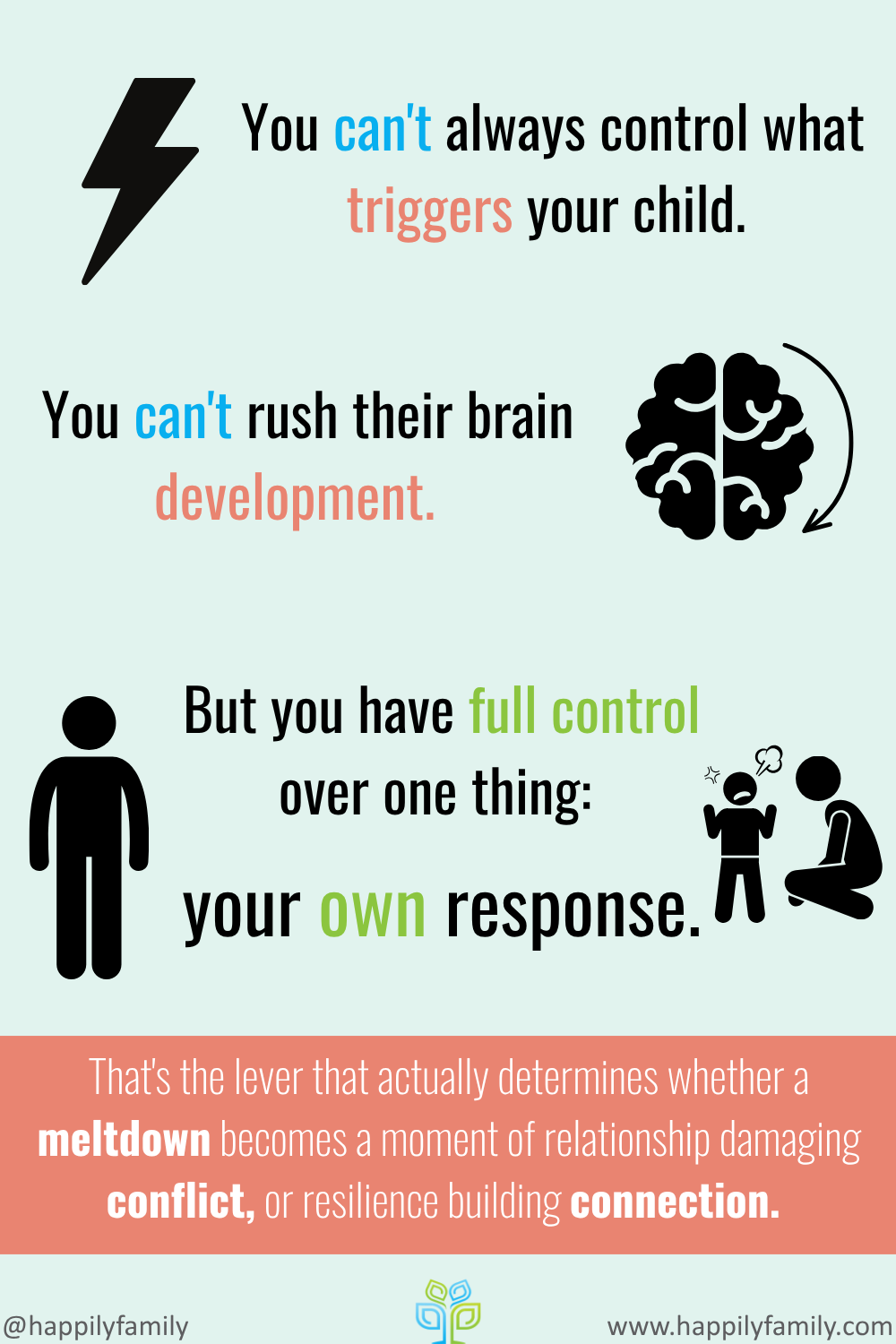
Here's the part most guides on managing meltdowns skip. You can't always control what triggers your child, and you can't rush their brain development. But you have full control over one thing: your own response. That's the lever that actually determines whether a meltdown becomes a moment of relationship damaging conflict, or resilience building connection.
Once you believe that in your body, not just your head, your whole approach to these moments shifts. You can stop bracing for a fight and start looking for what your child actually needs. This process begins by assessing your own needs first.
The 4 Steps for Managing Meltdowns In the Moment
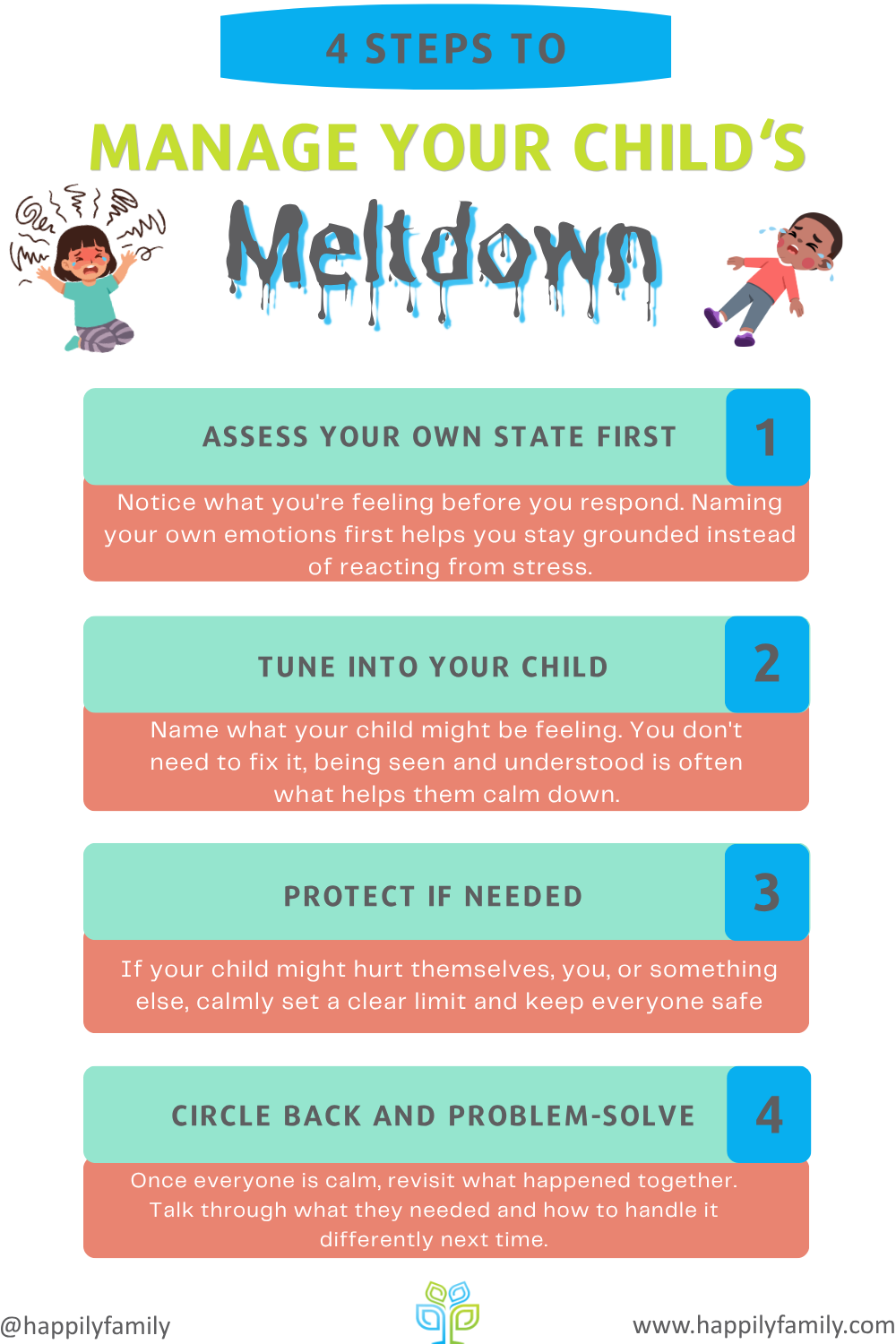
These are the same four steps I use with my own children, and the same ones I teach parents in our coaching work. Notice that step one is about you, not your child. That's not an accident. They work whether your child is two or twelve, and whether the meltdown is loud or quiet.
Step 1: Tune Into Your Own Thoughts and Feelings First
This one surprises people, because it seems backward. Shouldn't you focus on your child first?
Actually, managing meltdowns starts with you. Pay as much attention to soothing and grounding yourself as you're about to pay to your child.
In that grocery store parking lot, I was thinking, “I'm so embarrassed right now. People are watching and judging me. I don't even know what to do.” Naming that to myself, instead of pushing it down, is what let me get calm enough to actually help.
If you skip this step, you'll likely respond from your own stress instead of from a grounded, connected place. Children can feel the difference immediately.
Step 2: Tune Into Your Child's Thoughts and Feelings
Once you've checked in with yourself, turn your full attention to your child. Try to name what they might be feeling, out loud, in simple words.
In my case, once I was grounded, I could look at my child and think, “You're probably really mad, sad, and frustrated right now. You're disappointed, and this isn't what you expected.”
You don't need to fix the feeling or talk your child out of it. Simply being seen and understood is often what starts to bring the intensity down, even if it takes a few minutes.
Step 3: Protect, If You Need To
This step is optional, and you'll know if you need it. If your child is at risk of hurting themselves, hurting you, or breaking something, this is the moment for light, clear limits.
You might say, “I'm not willing for you to hurt yourself,” or “I'm not willing for you to hurt my body,” while calmly moving bodies or objects to keep everyone safe.
This isn't a punishment. It's protection, and it can happen at the same time as steps one and two, not instead of them.
Step 4: Circle Back and Problem-Solve Together
This step doesn't happen during the meltdown. It happens later, sometimes hours later, sometimes the next day, once everyone is calm.
Come back to the moment together. Ask questions like, “What happened at the store? What did you need from me? How could we handle that differently next time?”
This is where you and your child become partners, working out a plan for the future instead of just moving on and hoping it doesn't happen again.
Over time, this step is what actually reduces how often meltdowns occur.
Managing Meltdowns in Public Without Losing Your Mind
Public meltdowns come with an extra layer of difficulty: the audience. It's one thing to manage a meltdown at home, and another to do it while strangers are watching in the cereal aisle.
When You Feel Like Everyone Is Watching You
I want to normalize something. Feeling embarrassed during a public meltdown doesn't mean you're doing anything wrong.
Feelings are information; all feelings are okay. . Naming the feeling (even silently, in your own head) is part of Step 1 above, and it's often the difference between reacting out of shame and responding with calm.
Most of the people around you have either lived this exact moment themselves, or will someday. The ones who haven't yet aren't the ones whose opinion should guide how you handle your child's big feelings.
Build a Calming Plan Before the Next Meltdown Happens
The single biggest thing that's helped the parents I coach get better at managing meltdowns isn't something they do during the meltdown. It's the prep work they do beforehand.
Start by noticing your child's specific triggers. Is it loud, crowded places? Sudden changes to the plan? Being hungry, overtired, or rushed? Once you can name the pattern, you can often catch things before they escalate, or at least be ready when they do.
It also helps to have a “calm space” in mind, both at home and on the go. That might be a quiet corner with a few comfort items at home, or simply stepping outside or into a quieter aisle when you're out. For some kids, a familiar object, noise-reducing headphones, or sunglasses can take the edge off an overstimulating environment before it tips into a full meltdown.
Beyond the environment, it helps to know your own triggers too, and have a go-to phrase ready for yourself, so you're not figuring out your own reaction in real time on top of everything else.
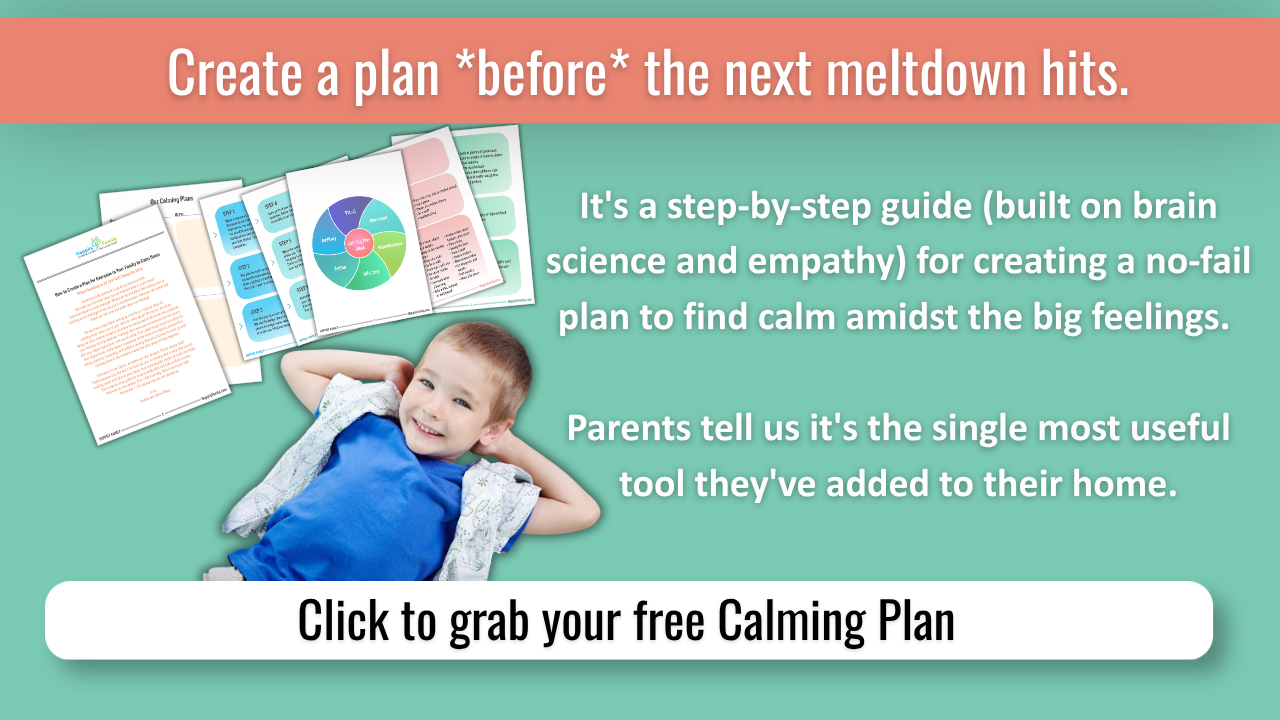
If you want help building this for your own family, we created a free Calming Plan worksheet. It walks you through exactly how you and your child can set up a plan before the next meltdown ever happens. You can grab it here, free.
Managing Meltdowns Long-Term: From Hard Moments to Connection
Here's what I want you to take away from all of this. Handling these moments well, over and over, is actually one of the most powerful ways to build a strong, trusting relationship with your child.
The Prep Work That Makes the Steps Easier
Before you're ever in the middle of a meltdown, it helps to understand your own patterns. What body sensations show up for you? What thoughts run through your head?
We wrote a full companion piece on this exact prep work, including journal prompts you can use before or after a meltdown to build this kind of self-awareness. The more familiar you are with your own reactions, the easier the four steps above become in the actual moment.
It's also worth knowing what not to do. We've written specifically about the phrases to avoid during a meltdown, since some well-meaning responses can actually make things harder.
The Child Mind Institute notes that praising positive behavior and teaching self-soothing skills like slow breathing between meltdowns (not during one) is what helps children build these tools over time. Managing meltdowns in the moment and teaching regulation skills afterward work together, not separately.
When Meltdowns Are Frequent or Intense
Occasional meltdowns are a normal part of childhood, especially for children between one and three years old. Some children are simply more sensitive to their environment than others, and that's a matter of wiring and temperament rather than a parenting failure.
That said, if your child's meltdowns feel more frequent, more intense, or harder to move through than what you see in other families, you're not imagining it, and you're not alone. Kids with sensory processing differences, ADHD, autism, or anxiety often experience the world as more overwhelming by default, which means managing meltdowns for these kids means paying close attention to triggers and lagging skills, not just responding in the moment. Our post on parenting the easily frustrated or explosive child goes deeper into this, including how to spot the unsolved problems underneath the behavior.
If that sounds like your family, our free Mindful Parenting for High Needs Kids conference brings together experts like Dr. Ross Greene (author of “The Explosive Child”) and Dr. Daniel Siegel to help you understand your child's specific wiring and respond in a way that builds connection instead of conflict. You can save your free spot here.
Meltdowns Don't End at Toddlerhood
Here's something that surprises a lot of parents. This doesn't stop being relevant once your child ages out of the toddler years.
Big feelings just look different in an eight-year-old, and different again in a teenager. The slammed door, the silent treatment, the sudden explosion over something that seems small… these are often the teen version of the same overwhelmed nervous system we talked about earlier.
If you're parenting a teen and finding yourself in these moments more than you'd like, our free Parent Teen Connection Conference was built for exactly this. It covers how to stay calm when emotions spike, understand the teen brain, and keep connection intact even during hard moments.You can join free here.
Managing Meltdowns Doesn't Mean Being Perfect
I want to leave you with this. I didn't handle every meltdown my kids ever had perfectly, and you won't either. That grocery store day wasn't my finest moment as a parent, at least not in the way it looked from the outside.
But it became a turning point, because I learned to tune into myself, tune into my child, protect when needed, and circle back later to problem-solve together. Those four steps, practiced imperfectly and repeatedly, are what actually build a relationship strong enough to handle the next meltdown, and the one after that.
You don't need to get this right every time. You just need a plan for the next time, and a way back to connection once the storm has passed.
Common Questions From Parents Like You
What causes a child to have a meltdown?
Common triggers include sensory overload (noise, crowds, bright lights), unexpected changes to a routine, hunger, and exhaustion. Often it's a combination of these building up until one more small thing, like being told “no”, that tips things over.
What are the four steps for managing meltdowns?
The four steps are: 1. tune into your own thoughts and feelings first, 2. tune into your child's thoughts and feelings, 3. protect yourself, your child, or your surroundings if needed, and 4. circle back later (once everyone is calm) to talk through what happened and problem-solve together.
How do I handle a meltdown when we're out in public?
=Start with yourself. Name what you're feeling (embarrassed, anxious, rushed) instead of pushing it down, since that awareness helps you respond calmly instead of reactively. From there, the same four steps apply, whether you're at home or in the middle of a grocery store.