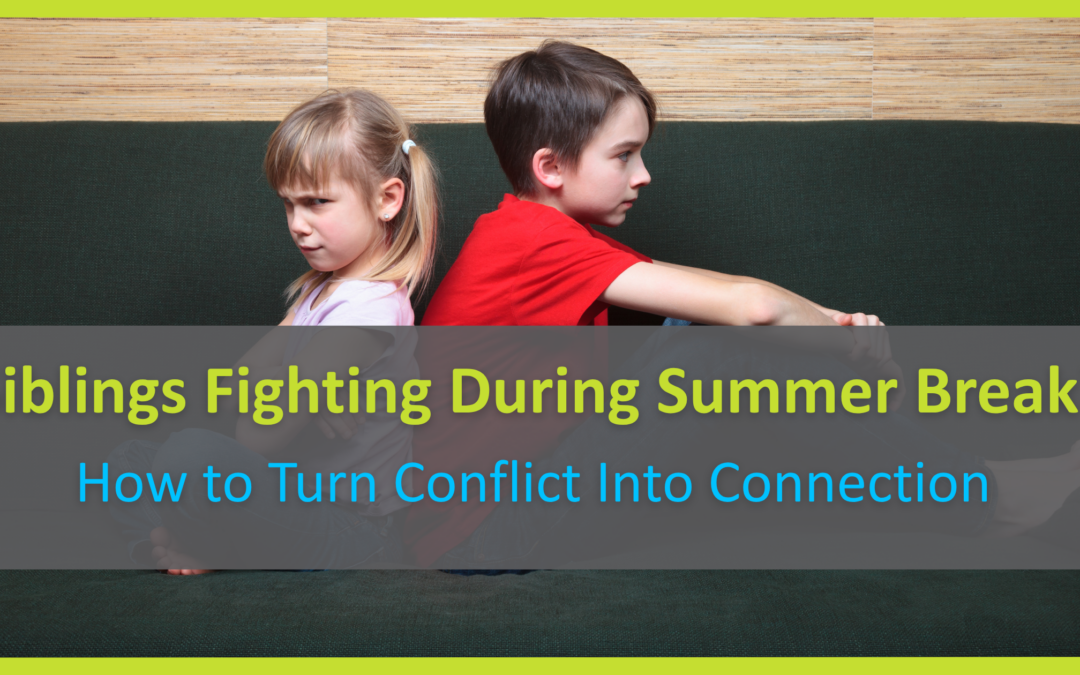
If siblings fighting during summer break has become the soundtrack of your home, you're not alone. Summer break is often filled with big expectations. We imagine slower mornings, family adventures, backyard fun, and siblings making lifelong memories together.
Then reality arrives.
Within days (or hours), the arguing starts. One child takes the other's toy. Someone feels left out. Someone else shouts, hits, or storms away. Before long, you're stepping into another disagreement and mentally beating yourself up about how your children seem to spend more time fighting than enjoying each other's company.
Many parents find that siblings fighting during summer break increases because routines disappear, children spend more time together, and everyone has less personal space.
The good news is that siblings fighting doesn't necessarily mean your children dislike one another. In fact, conflict between siblings is a normal part of learning how to share, communicate, solve problems, and navigate relationships (at all ages!). The goal isn't to eliminate every disagreement. It's to help your children develop the skills they'll carry into every relationship throughout their lives.
Why Sibling Fights During Summer Break Often Get Worse
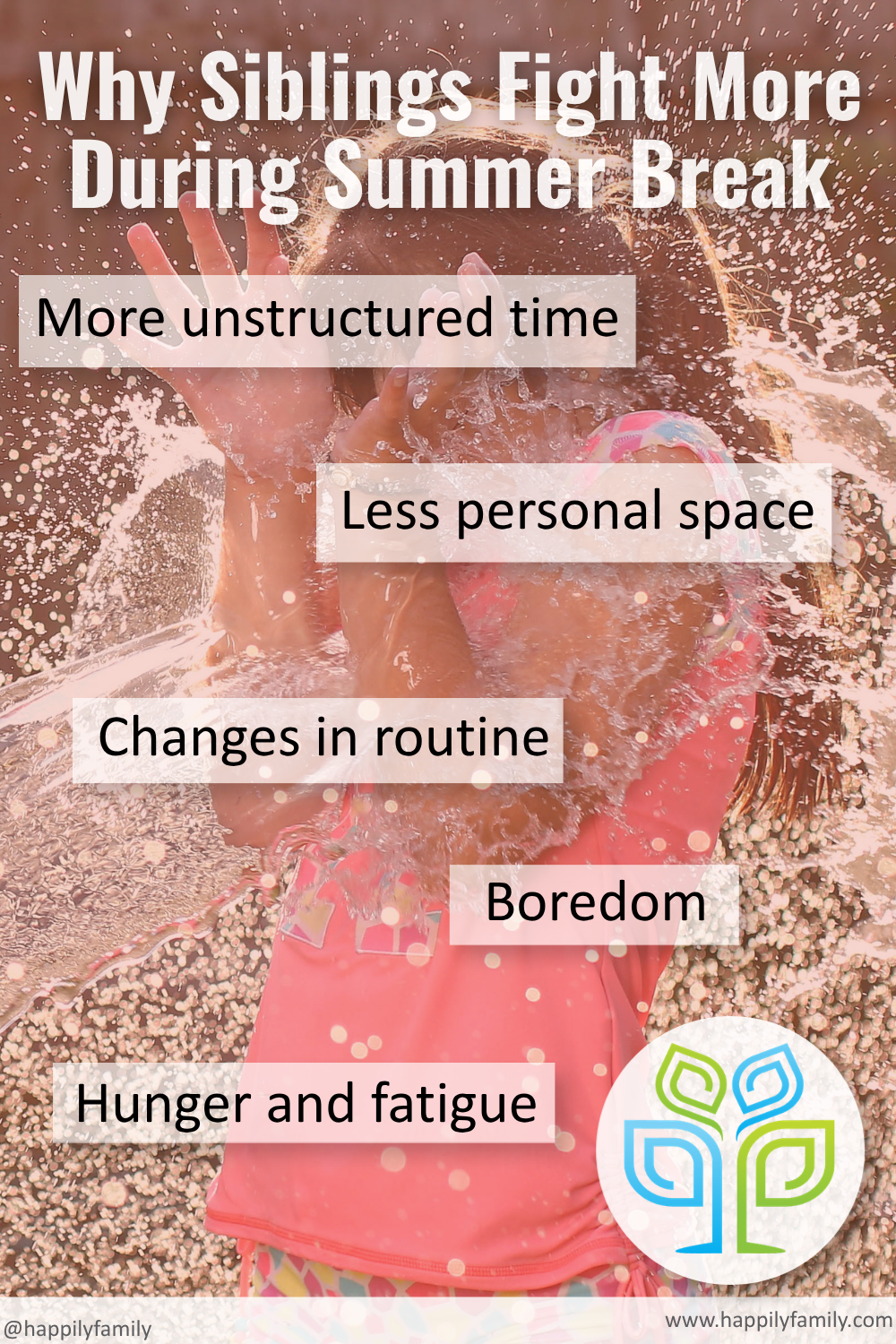
Siblings often fight more during summer break because they spend more unstructured time together, have fewer daily routines, experience more boredom, and have less personal space than they do during the school year. While the increase in sibling conflict can feel overwhelming, these disagreements are a normal part of children learning emotional regulation, communication, and problem-solving skills.
More time together can lead to more conflict
During the school year, children naturally have opportunities to recharge. They spend time with friends, teachers, classmates, and have different activities throughout the day.
Summer changes that rhythm.
Instead of having natural breaks from one another, siblings often spend hours together every day. Even children who genuinely love each other can become overwhelmed when they have little space to themselves.
Boredom can also play a role. When children don't know what to do next, small frustrations often grow into much bigger conflicts. A disagreement over whose turn it is or who gets the last popsicle can quickly become an emotional explosion.
This doesn't mean you're doing anything wrong. Your kids are going through the growing pains of navigating a new dynamic in their relationship, as the American Academy of Pediatrics notes, sibling rivalry is a normal part of growing up, but it doesn’t need to take over your entire summer.
What your child's behavior may really be communicating
One of the easiest traps to fall into is focusing only on the behavior we can see, rather than trying to understand the cause of the behavior.
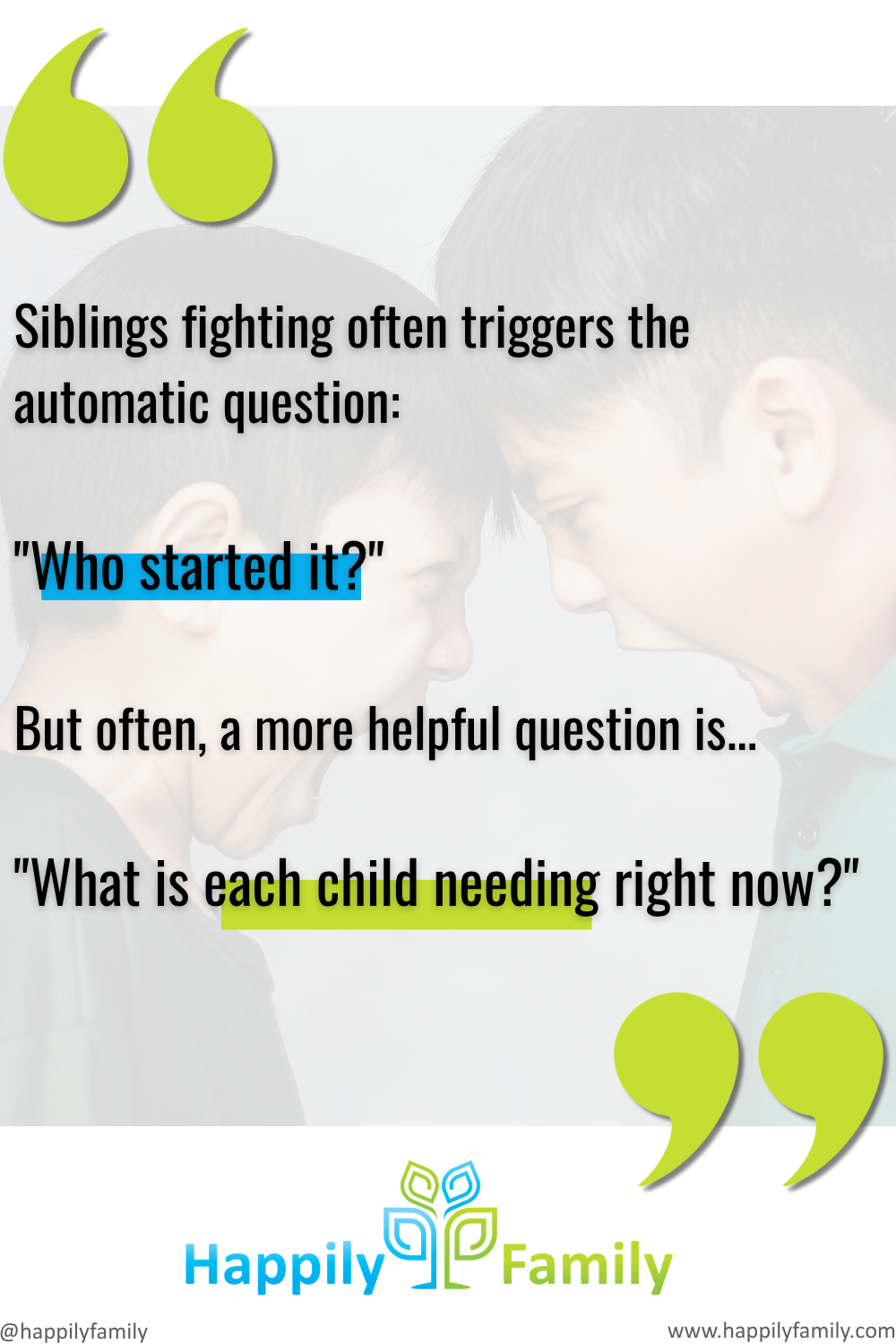
Siblings fighting often triggers the automatic question:
“Who started it?”
But often, a more helpful question is…
“What is each child needing right now?”
A child who is constantly provoking a sibling may be craving connection, or struggling with a dysregulated sensory system.
A child who lashes out might be feeling overwhelmed after a busy morning, or hangry from not eating on the same consistent timeline they are used to.
Another child may simply be struggling with disappointment after hearing “no.”
When we become curious about what's driving the conflict, we begin responding differently. Instead of immediately assigning blame or punishment, we can start teaching emotional awareness, problem-solving, and empathy. This doesn’t mean that we ignore the behavior or make excuses for the child, but that we look more deeply into what is happening underneath the behavior to discover the true cause. For example…
Many sibling disagreements aren't really about the toy, the game, or whose turn it is. They're often a sign that one or both children are struggling with emotional regulation (ex – maybe they’ve used all the words they have access to, and they resort to hitting instead.)
As children learn to recognize, name, and manage big feelings, they're better equipped to navigate conflict with their siblings. If you'd like to explore this further, our article on Helping Children Learn Emotional Regulation is a great next read.
That doesn't mean there shouldn't be boundaries. If someone is being hurt physically or emotionally, it's important to step in quickly and calmly.
But after everyone is safe, curiosity and shame-free problem-solving lead to more lasting solutions than simply deciding who was right and who was wrong.
Why constant refereeing usually doesn't solve the problem
When siblings fight, it’s exhausting for everyone involved.
Many parents describe feeling like full-time referees, constantly separating children, settling arguments, and trying to keep the peace. One parent in our community shared that she often felt she had to protect her children from one another because the fighting seemed never-ending.
It's understandable to want the conflict to stop immediately.
But if every disagreement depends on a parent deciding the winner, (you create great “job security” for a role you do not want. And children miss valuable opportunities to build conflict-resolution skills for themselves.
Of course, young children still need plenty of support. They aren't expected to solve every disagreement independently, but you can set them up for long-term success by switching up how you view your role.
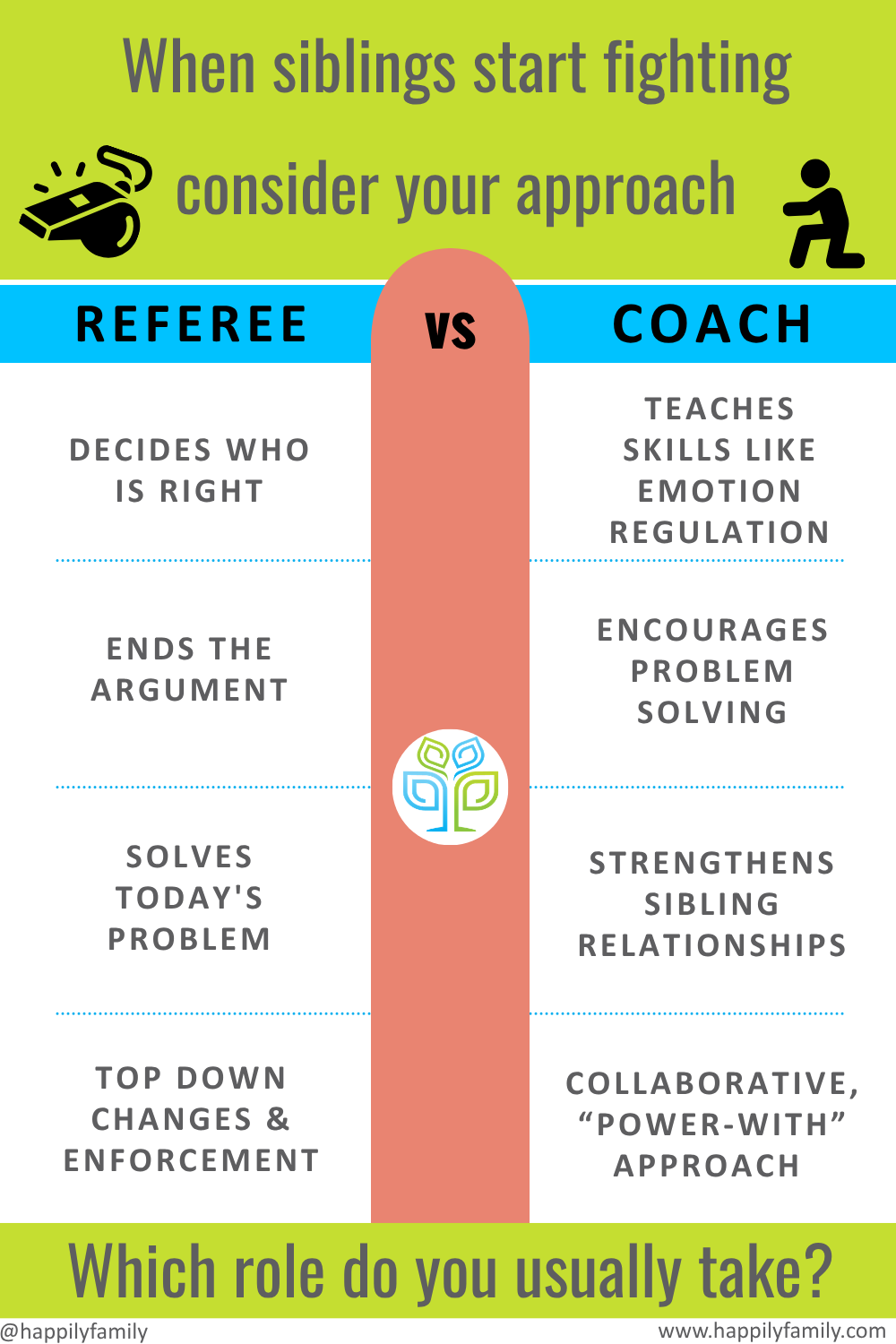
Instead, think of yourself less as a referee and more as a coach.
A referee decides who broke the rules.
A coach helps children learn new skills.
Over time, your goal is to help your children recognize emotions, express needs respectfully, listen to each other's perspectives, and work together toward solutions. These are life skills that will serve them long after summer break is over.
How to Respond When Sibling Fighting Starts
Stay calm before stepping into the conflict
When you hear raised voices from the next room, your nervous system reacts, too. If you've already broken up five arguments before lunch, it's understandable to feel frustrated.
The challenge is that children often borrow our emotional state. When we enter the situation feeling rushed, angry, or anxious, it can unintentionally add fuel to the conflict.
Instead, take one slow breath before stepping in.
Your first priority is always safety. If someone is being hurt, calmly separate the children.
Once everyone has had a chance to settle, you can begin helping them understand what happened.
Rather than asking, “Who started it?” try asking questions like:
- “Can you help me understand what happened?”
- “What were you hoping for?”
- “Sounds like you were really angry, is that how you felt?”
- “How do you think your brother or sister felt?”
- “What could we try differently next time?”
These questions encourage reflection instead of defensiveness. Over time, they help children build emotional awareness and problem-solving skills.
Help each child feel seen before solving the problem
One of the hardest parts of parenting siblings is that both children often feel wronged.
One child may be angry because their tower was knocked over.
The other may be hurt because they felt excluded from the game.
Both experiences can be true.
Helping each child feel understood doesn't mean agreeing with hurtful behaviour. It simply means acknowledging the emotions underneath it.
You might say:
“You worked really hard on your tower and felt upset when it fell.”
Then turn to the other child…
“You wanted to play too, and you felt frustrated when you weren't included.”
When children feel heard, they're often much more willing to listen to someone else's perspective.
Research on emotion coaching, including the work of the Gottman Institute, suggests that acknowledging a child's feelings before moving into problem-solving helps children develop stronger emotional regulation over time.
Teach skills instead of assigning blame
Every disagreement is an opportunity to practice a skill.
Instead of focusing only on stopping siblings fighting, think about what your children need to learn.
That might include:
- taking turns
- asking before borrowing
- respecting personal space
- using words instead of physical aggression
- noticing another person's feelings
- repairing after mistakes
Children aren't born knowing these skills.
They learn them through repetition, gentle coaching, and seeing them modelled by the adults around them.
It can be tempting to focus on stopping the behaviour as quickly as possible, but lasting change usually happens through connection, coaching, and practice rather than punishment alone. If this approach feels different from how you were raised, you may enjoy reading “The Best Way to Support A Struggling Child” where we explore why relationships are one of the most effective tools we have for guiding behaviour.
There will still be difficult days. Success in sibling relationships isn't defined by an absence of conflict, but rather by their growing ability to repair, reconnect, and navigate disagreements on their own.
Prevent Sibling Fighting Before It Starts
Create rhythms that reduce tension
One of the biggest reasons siblings fight more during summer break is that children lose the predictable rhythm they're used to during the school year.
That doesn't mean every minute needs to be scheduled.
In fact, children benefit from plenty of free play.
What often helps is creating gentle anchors throughout the day.
Simple routines like shared breakfasts, outdoor time after lunch, quiet reading in the afternoon, or a family walk after dinner create moments of predictability that help children feel secure.
When children know what comes next, they often experience less stress, which can reduce conflict.
Protect one-on-one connection with each child
Children naturally compete for attention.
Sometimes what looks like jealousy is actually a child asking, “Do I still matter to you?”
Even ten or fifteen minutes of uninterrupted one-on-one connection can make a meaningful difference.
You don't need elaborate activities.
Read together.
Shoot baskets.
Bake muffins.
Go for a walk.
Invite your child into whatever you're already doing.
Connection doesn't eliminate every disagreement, but it often fills emotional buckets that make cooperation easier.
Set up your home for more cooperation and less competition
Some conflicts are preventable simply by looking at your environment.
Ask yourself:
- Are there toys that consistently create arguments?
- Do the children have opportunities to play separately?
- Are they hungry or tired when most disagreements happen?
- Have they had enough movement today?
- Are expectations clear?
Small adjustments can prevent many of the situations that lead to siblings fighting before emotions become overwhelming.
Building Strong Sibling Relationships That Last Beyond Summer
Small moments of connection make a big difference
When parents search for help with siblings fighting, they're often hoping for a quick fix.
The truth is that healthy sibling relationships are built slowly.
They grow through shared laughter…
Helping each other build blanket forts…
Celebrating small wins…
Repairing after mistakes…
And learning that disagreements don't have to threaten the relationship.
As parents, we don't need to create perfect harmony.
We simply need to keep creating opportunities for connection.
Every disagreement your children work through with support becomes another opportunity to build resilience. Over time, those everyday moments help children develop empathy, flexibility, and confidence in relationships. If you'd like to dive deeper into this idea, our article on Raising Resilient Kids shares practical ways to nurture these lifelong skills.
When siblings’ fighting may be a sign of a deeper need
While conflict is normal, there are times when it's worth looking more closely.
If one child is consistently being hurt physically, if the conflict is becoming increasingly aggressive, or if one child seems fearful of the other, additional support may be needed.
Likewise, if sibling fighting during summer break suddenly becomes much more intense than usual, consider whether there may be underlying stressors such as anxiety, major life changes, sleep challenges, sensory needs, or difficulties with emotional regulation.
Looking beneath the behavior is one of the most powerful ways to create lasting change because behavior is communication.
You don't have to figure it all out alone
If you're exhausted from constantly stepping into arguments, please know this…
You're not failing.
You're parenting through one of the most common challenges families experience.
The fact that you're looking for better ways to respond tells us something important about you. You care deeply about your children and about the relationship they have with each other.
Those small moments of curiosity, connection, and compassion add up over time.
Sibling conflict doesn't always disappear as children get older. In many families, the arguments simply become more complex as tweens and teens navigate growing independence, friendships, and changing family dynamics.
Common Questions From Parents Like You
Is sibling fighting during summer break normal?
Yes. Spending more unstructured time together, changes in routine, boredom, and fewer opportunities for personal space can all contribute to increased sibling conflict during the summer months. Most disagreements are a normal part of learning relationship skills.
When should I step in during siblings fighting?
Step in immediately if someone is at risk of being hurt physically or emotionally. Once everyone is safe, focus on helping each child understand what happened, express their feelings, and practice healthier ways to solve the problem together.
How can I reduce sibling fighting without constantly punishing my children?
Rather than relying only on punishment, focus on teaching emotional regulation, creating predictable routines, strengthening your connection with each child, and coaching conflict-resolution skills. Over time, these approaches help children build the tools they need to manage disagreements more independently.