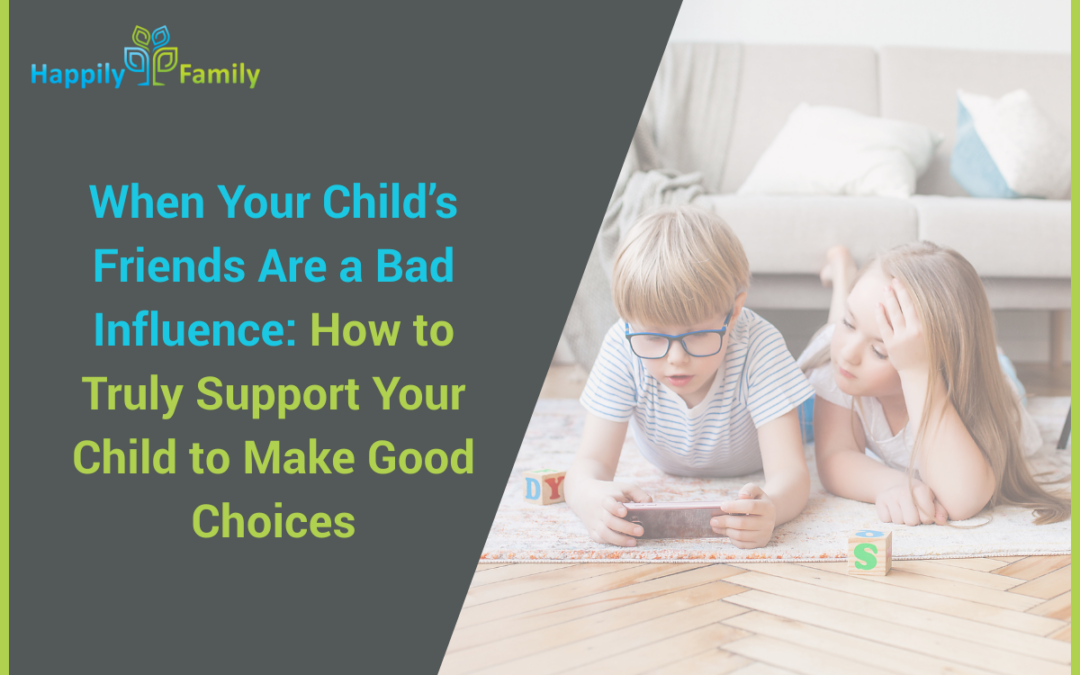
A mom recently wrote to us and shared something that might sound familiar…
“My 7-year-old daughter is easily influenced by her peers. If her friends are doing well, that’s great. She follows directions and cooperates. But if her friends do something bad, she follows them and gets into trouble. She’s a well-behaved, happy girl who gets along with others and listens. What would be an effective way to show her that she can be strong and that she can stand up for herself when a bad influence comes? I don’t want to tell her who to be friends with, but how do I help her build her internal strength and be less influenced by her peers?”
Can you relate to this? As a parent, have you watched your child pick up behaviors from a friend that makes your stomach drop a little?
I can relate to this on a personal level with some of my closest friends right now. My friends and I volunteer at the same place, and they all want to do something that I think is a bad idea for the organization. Here I am, as an adult with decades of life experience, still trying to decide if I’m going to stick to my principles, possibly risk my friendships, and say no… or give up my ideals, and follow along with the crowd. So when we talk about struggles with friends, know that this isn’t just a kid problem. It’s a human one.
But bringing it back to parenting, the question that so many of us have is: How do we help our children navigate friendships that worry us, without pushing them away in the process?
The good news is, even when your child's friends are a bad influence, you have more influence than you think. And it doesn’t require controlling who your child spends time with. It starts with connection.
Why Your Child’s Friends Matter So Much (And Why That’s Actually a Good Thing)
Humans Are Wired for Connection
Before we jump into what to do when your child’s friends are a bad influence, let’s take a step back and remember something important: we are social beings. The desire to belong, to be part of a group, to feel accepted by our friends… this isn’t a flaw. It’s part of our survival wiring.
Over the course of human history, we lived in nomadic, interconnected hunter-gatherer groups for far longer than we’ve lived in nuclear families, in relative isolation from one another. In early human history, being “kicked out of the group” meant you were likely going to die. Even today, our modern brain carries some of this ancient programming. When our brain senses social exclusion, it activates the same neural pathways that process physical pain.
Research in developmental neuroscience has shown that, especially during adolescence, the brain undergoes what scientists call a “social reorientation,” becoming increasingly attuned to peer feedback and social rewards (you can read more about this research at the National Institutes of Health).
This isn’t your child being “weak” or lacking character.
It’s their brain doing exactly what it’s designed to do at this stage of life.
So when your child follows their friends into behavior you don’t love, they’re not broken. They’re human.
Some Peer Influence Is Actually Positive
Here’s something that’s easy to forget when you’re worried about your child’s friend: peer influence goes both ways. Your child’s friendships might also be the reason they tried out for the school play, started reading a new book series, or learned to share more generously on the playground.
Children’s friends help them learn cooperation, develop empathy, practice conflict resolution, and build the social and emotional intelligence that will serve them for the rest of their lives. As the American Academy of Pediatrics notes, peer relationships are one of the most important contexts for teaching children empathy and helping them develop a social support system beyond the family.
The challenge for your child is to learn the difference between when they’re being positively or negatively influenced by their friends, and then to develop the inner strength to go against the crowd when it matters. Both of these are essential parts of human development that, honestly, even adults are still working on.
If you’re looking for ways to build that kind of emotional resilience in your children, our free parenting conference features expert interviews on exactly this topic, including conversations with Dr. Daniel Siegel about how secure attachment helps children navigate social challenges with more confidence.
What to Do When Friends Are a Bad Influence on Your Child
Resist the Urge to Criticize Their Friends
When you suspect your child is picking up concerning behavior from a friend, every instinct in your body might be screaming: “Just tell them to stop hanging out with that kid!”
But here’s what the research actually shows (and what parents who’ve been through this will tell you): criticizing your child’s friends almost always backfires. A recent study published in Scientific American found that when parents openly disapproved of their child’s friendships, the child’s behavior didn’t improve. In many cases, it actually got worse.
Why? Because when we criticize our child’s friends, it feels to them like we’re criticizing a part of who they are. Their natural response is to defend their friendships, sometimes more fiercely than before. And if they feel like they have to choose between you and their friends, you may not like the outcome.
This doesn’t mean you stay silent.
It means you approach the situation differently.
Lead with Curiosity, Not Control
When friends are a bad influence, your instinct might be to tell your child what to think. But try asking questions that help them think for themselves instead. This is one of the most powerful things you can do as a parent, and it works whether your child is 5 or 15.
Your instinct might be to lecture. But questions open doors to critical thinking that lectures close. Here are some conversation starters you can try (not all at once, but over the days, weeks, and months):
- What qualities do you look for in a friend? What qualities do you not want your friends to have?
- How do you feel when you’re with [friend’s name]?
- Have you ever had to end a friendship? How do you know when it was time to end it?
- If you could change something about your friendship with [friend’s name], what would you change?
- What advice would you give someone whose friend wanted them to do something that didn’t feel right to them?
- When you did [specific behavior] with your friends, how did it feel afterward?
- What could you say to a friend who wants you to do something that doesn’t feel safe?
By asking these kinds of open-ended questions, you’re helping your child develop critical thinking skills. You’re empowering them to reflect on their own experiences and notice the difference between friends who lift them up and friends who pull them down. Over time, this kind of reflection builds the internal strength they need to stand up for themselves and to tune into their own inner wisdom.
If you want to learn more about how to use questions to connect with your child (instead of lecturing), we have a whole blog post about asking your child questions to build connection and critical thinking.
Focus on Behavior, Not the Friendship
Here’s another shift that can make a huge difference: instead of making the conversation about who your child is spending time with, make it about the specific behavior that concerns you.
For example, instead of saying “I don’t like it when you hang out with Jayden,” try something like, “I noticed you’ve been using some language that’s different from what we use in our family. Can we talk about that?”
This approach does two important things. First, it keeps you curious. Our kids pick up language, behaviors, and ideas from any number of sources. If we jump in with assumptions or judgments about our child or their friends, we might end up eroding the trust and relationship with our child that we are trying so hard to build.
Secondly, since we can’t possibly control where our child gets information from at all times, the best thing we can do is to help them develop their own critical thinking skills and to trust in their own wisdom. Asking open-ended questions gives your child room to reflect on their own behavior without them getting defensive about their friendships.
Building Your Child’s Inner Strength to Handle Friends Who Are a Bad Influence
Your Relationship Is the Foundation
Here's something that might bring you some relief: when your child's friends are a bad influence, the single most protective factor isn't monitoring or consequences. It’s your relationship with your child.
When children feel securely connected and not controlled by their parents, when they know they can come to you without judgment, they are far more likely to talk to you, and make healthy choices even if their friends are making questionable ones. Dr. Daniel Siegel’s research on attachment and parenting has shown that children who experience consistent, responsive relationships with caring adults develop a fundamental sense that they are seen, safe, and supported. That foundation becomes their compass when navigating tricky social situations.
This is what we talk about at Happily Family when we say we believe in “power with” parenting rather than “power over.” It’s not about controlling your child’s behavior or their friendships. It’s about building a relationship strong enough that your child wants to come to you when things get complicated, and keeping conversations open and curious without fixing or rescuing, so your child develops strong thinking and problem-solving skills.
If you’re looking for practical tools to strengthen that connection, our Calming Plan guide can help you show up for your child with more patience and presence, even on the hard days.
Help Them Practice Standing Up for Themselves
Knowing the right thing to do and actually doing it in the moment are two very different things. (We all know that as adults, right?) So one of the most helpful things you can give your child is practice.
Role-playing might sound silly, but it’s incredibly effective. You can create low-pressure scenarios at home where your child practices saying things like:
- “I don’t want to do that, but I still want to hang out with you.”
- “That doesn’t feel right to me. Let’s do something else.”
- “My parents would be really upset if I did that, so I’m going to pass.”
Give your child permission to use you as the “bad guy” when they need an exit strategy. Let them say “My mom won’t let me” if that helps them navigate a tricky situation with their friends. Sometimes having an out is exactly what a child needs to avoid the situation without losing their social standing.
Model What Healthy Friendships Look Like
This might be the most overlooked piece of the puzzle, but it’s one of the most powerful: your children are watching how you handle your own friendships.
Do you set boundaries with friends when you need to? Do you speak up when something doesn’t feel right? Do you give so much to other people that there is nothing left for yourself?
Or, like me, with the organization that my friends and I volunteer for, are you able to go against the crowd when something doesn’t align with your values?
It’s okay to be honest with your kids about this. You can say something like, “I’m working on this too. It’s hard to go against your friends sometimes, even when you know it’s the right thing to do.” That kind of vulnerability doesn’t make you look weak. It makes you relatable. And it shows your child that standing up for yourself is a lifelong practice, not something you just magically figure out one day.
We talk about this idea a lot in our blog post about how the best parenting advice starts with looking at yourself first. Because the truth is, the way we show up in our own relationships teaches our children more than any conversation ever could.
When to Step In (And When to Step Back)
Trust the Process (Even When It’s Hard)
Most of the time, when it comes to concerns about a friend’s bad influence, the best approach is to ask questions, listen without judgment, share your values, and trust your child to work through it.
Kids, given enough time and space, can tell the difference between friends who positively influence them and friends who pull them in a direction that doesn’t feel good. Over time, children develop the personal strength to follow their own internal wisdom and stand up for themselves.
This doesn’t mean you do nothing. It means you play the long game. Every conversation you have and question you ask, every time you help them understand their experience and remind them that they will figure it out, every time you listen without jumping to fix it… You’re adding another layer of strength to your child’s foundation.
If you’re parenting a teen and navigating the additional complexity that adolescence brings to friendships, our free teen parenting conference offers expert guidance from psychologists like Dr. Daniel Siegel and Dr. Laura Markham on staying connected during these pivotal years.
Know When to Draw the Line
With all of that said, there are times when stepping in is the right call. If your child’s friendship is leading to behavior that puts their safety at risk (think substance use, bullying, illegal activity, or any situation where someone could get hurt), you might need to set limits.
In those situations, be direct and clear about what you are willing and not willing to do, while still leading with empathy for your child’s feelings. You might say something like, “I know this is going to be hard. I understand that you care about your friend. And your safety matters, so I need to set a boundary here.”
Setting limits doesn’t have to mean severing a friendship entirely. It might look like only allowing time with that friend at your home. Or picking up your child earlier from a social event.
The key is to set the limit and maintain the connection. Your child needs to know that even when you disagree with their choices, you are still on their team.
And remember, you are wise to be cautious about telling your child who to be friends with. But that doesn’t mean you can’t do anything. You can still help your child to be thoughtful about their friendships and to reflect on how much those friendships impact their behavior and choices. The relationship you’re building with your child right now and their ability to tune into their own inner wisdom are the things that will guide them when you’re not there.
Common Questions From Parents Like You
How do I know if my child’s friend is actually a bad influence or if it’s normal kid behavior?
It’s normal for children to experiment with new behaviors, language, and attitudes as they grow. In addition to their friends, kids are influenced by many different things in their lives, and most of that influence is positive. A temporary change in behavior doesn't necessarily mean you're dealing with a friend's bad influence. Look for sustained patterns: Is your child consistently more disrespectful, anxious, or secretive after spending time with a particular friend? Are their interests, values, or self-esteem shifting in a direction that concerns you? Either way, it can be helpful to have an open conversation. Staying curious and connected (rather than reactive), helping your child to tune into how they feel when they are with that friend, how they feel when they act a certain way, and if there are better ways to meet their needs, will help your child work through things on their own.
Should I forbid my child from seeing a friend I think is a bad influence?
In most cases, outright banning a friendship tends to backfire. Research shows that when parents prohibit friendships, children often become more secretive, more drawn to the forbidden friend, and less likely to come to their parents for guidance. Instead, focus on keeping communication open, reinforcing your family values, and helping your child develop the critical thinking skills to evaluate their own friendships. That said, if a friendship is putting your child in physical or emotional danger, setting firm and clear boundaries could be appropriate and necessary. The goal is to protect your child’s safety, build their critical thinking skills, and preserve your relationship with them.
At what age should I start talking to my child about their friends?
It’s never too early to start building the foundation. Even with preschoolers, you can begin having simple conversations about what makes a good friend, how different people make us feel, and what to do if someone asks them to do something that doesn’t feel right. As children move into elementary school and their social world expands, these conversations naturally become more nuanced. And by the time your child reaches the preteen and teen years (when peer influence peaks), you’ll have years of practice having these discussions in a way that feels natural rather than forced. It’s never too late to start, but the earlier you do, the easier it becomes for your child to talk to you about their thoughts, feelings, and challenges with their friendships.