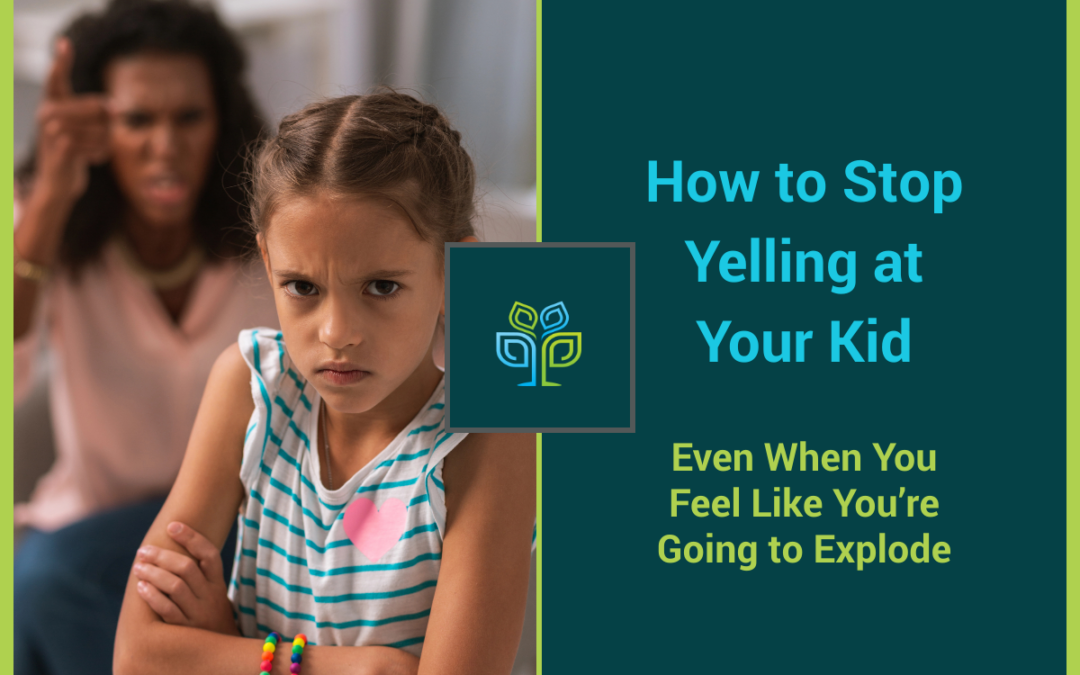
No parent wakes up in the morning and thinks, “I can't wait to yell at my kids today.” And yet, so many of us find ourselves doing exactly that …sometimes before we even realize our mouths are open.
If you've ever stood in your kitchen, mid-tirade, and thought, How did I even get here? I sound like a crazy person; you are in good company. It’s easily one of the biggest challenges parents come to us with. The guilt, the regret, and that sinking feeling that you're somehow damaging your child. It's heavy.
But here's what we want you to know: yelling doesn't make you a bad parent.
It makes you a human being who has reached the end of their rope.
It might sound crazy, but you can learn how to stop yelling at your kids.
It’s not by being perfect, but by understanding what's really happening inside you when you lose it, and building new habits one small moment at a time.
Over the years, we have had the honor of sitting down with two incredible experts on this topic: Dr. Laura Markham, clinical psychologist, founder of Aha! Parenting, and author of Peaceful Parent, Happy Kids: How to Stop Yelling and Start Connecting; and Dr. Lynyetta Willis, psychologist and family empowerment coach who created the Elemental Living® Model and the Trigger Transformation Toolkit.
What they shared changed how we think about yelling, and we think it will change things for you, too.
Pssst – You can watch both interview clips at the end of this post.
Why You Yell (And Why It's Not What You Think)
Your Body Goes Into Fight Mode Before Your Brain Catches Up
Here's something most parents don't realize: when you're yelling at your child, your body is in a state of fight, flight, or freeze. Even though you know, logically, that they're just a kid being a kid, your nervous system has unconsciously clocked your child as a threat.
As Dr. Laura Markham explained in our interview, when that fight response kicks in, “you see your kid is the enemy. You're in fight mode.” Your body floods with stress hormones and neurotransmitters designed to help you survive a dangerous situation. Your heart races. Your jaw tightens. And before you know it, you're screaming about shoes left in the hallway like it's a five-alarm emergency.
That's not a character flaw. That's your nervous system doing what it was designed to do. It just isn't very helpful when your three-year-old is refusing to put on pants.
Your Triggers Are Older Than Your Children
Dr. Lynyetta Willis shared something in our conversation that stopped us in our tracks. She explained that when your child does something that sets you off, what you're really reacting to is often much older than that moment.
Dr. Willis shared a personal example: her daughter said, “Mommy's dumb,” and she noticed the wave of anger felt way too big for the situation. Instead of reacting out of anger, she chose to get curious about why her anger was so big. So she sat with it and used her Four Elements tool (we’ll teach you how to use it a little further down the in this blog post.)
She checked in with her body and noticed tension in her shoulders and her tight jaw. She noticed her thoughts: She can't talk to me that way. She's so ungrateful. I have absolutely no control. And her feelings: anger, helplessness, shame, and confusion.
She allowed those sensations, thoughts, and feelings to sink in and then asked herself: “When is another time that I experienced these sensations, thoughts, and feelings?”
What came up was a memory from when she was about 12 years old. She'd told an adult that another child was bothering her, and the adult told her that she didn't matter as much as the other child. “So for me,” Dr. Willis explained, “my child saying ‘Mommy is dumb' was really triggering something that happened to me when I was 12. And so my body and my brain are reacting like I was when I was 12 years old.”
When we can bring some compassion to that younger version of ourselves (when we can give “water”, as Dr. Willis beautifully puts it, to the part of us that's still hurting) the charge of the present moment starts to lose its grip. Suddenly, “Mommy's dumb” becomes what it actually is: a frustrated little person who doesn't have the words to say what they really feel. She shared that after doing this quick, internal exercise, she was able to respond to her daughter with intention, instead of reacting out of anger which her first instinct was to do.
How to Stop Yelling at Your Kids: Quick In-the-Moment Tools
Dr. Laura Markham's "Stop, Drop, and Breathe"
Dr. Markham shared a deceptively simple technique that can interrupt the vicious cycle of yelling before it spirals. When you catch yourself yelling—even mid-sentence—here's what she says to do: Stop. Drop your agenda. Breathe.
As Dr. Markham explained, that single deep breath sends a signal to your nervous system that the danger isn't real. “Your body says, ‘Oh, I guess maybe it's not an emergency after all,'” she told us. And when your body gets that message, it begins to slow the flood of stress hormones that were priming you to fight. “[Your body] gets the message ‘we don't have to go off this cliff’,” she said. “And then you have a choice of what to do.”
That deep breath literally changes your physiology. Your thinking brain starts to come back online. And suddenly, where there was only reaction, there is now a choice.
Many parents tell us, “I just find myself yelling. I don't even know how I got there.” But Dr. Markham reassured us that when parents start paying attention, they discover they can stop—even while they're already yelling.
And here's the part that changes everything: “You're not losing face when you stop. You're modeling anger management that's healthy for your child. And you might even see your child stop in the middle of yelling at a sibling in the future too.”
Stop, drop, and breathe, is an excellent in-the-moment strategy that really does work!
Rate Your Frustration: The "ELF" Scale
Dr. Willis also shared a simple but surprisingly effective tool: rate your frustration on a scale of 1 to 10. She calls this your Elemental Level of Frustration, or ELF. One means “I'm cool as a cucumber.” Ten means “Back up, I'm going to blow.”
If your child says something rude and you're at a 9, that's important information. “If I'm at a nine, clearly there's something going on here,” Dr. Willis explained. “Clearly, this is bringing up something else for me.” That awareness alone gives you enough space to choose a different response. Just knowing your number can be enough to stop a fight or flight reaction from happening without your conscious control.
If you need more support building your own calming strategies, we created a free Calming Plan based on brain science and empathy that walks you through creating a personalized plan for your whole family.
Noticing Your Patterns: How to Stop the Yelling Cycle Before It Starts
Dr. Markham's "Gathering Kindling" Metaphor
Dr. Laura Markham shared an image we use to understand why we explode: throughout our day, we're “gathering kindling for a bonfire.” Every small frustration, the spilled cereal, the ignored request, the mess, the noise, is another stick on the pile.
“Sooner or later, you get enough kindling and you're gonna have a big conflagration,” she told us. And then your child does one relatively small thing and—boom. The whole thing ignites. It looks like you're overreacting to this moment. But really, you're reacting to everything that came before it.
The most exciting shift parents report is when they start noticing the kindling before the bonfire starts. They recognize the grumpy mood, the shortened patience, the “everything is setting me off” feeling. And they can say to themselves: Stop. Self-care is needed here.
As Dr. Markham put it, “Our job is to calm the storms. There's going to be childish behavior in your house. So our job is to accept the childish behavior with as much good humor as we can and keep ourselves in enough of a sense of well-being and balance that we can be emotionally generous.”
Dr. Lynyetta Willis's Four Elements
Dr. Willis created a powerful reflection tool that uses the four elements—earth, air, water, and fire—to help parents understand their triggers at a deeper level and will help your nervous system to go into fight or flight less frequently. She recommends going through this exercise after you experience triggers, not during them, especially when you first start using it.
At the top of the page, we shared an example of one of the elements in action.
Here’s the breakdown of how it works:
Earth (Body Sensations): What did you feel in your body? Tension in your shoulders? Tight jaw? Clenched fists?
Air (Thoughts): What stories were running through your head? Things like “She can't talk to me that way” or “I have absolutely no control.”
Water (Feelings): What emotions came up? Anger? Helplessness? Shame? Confusion? Often it's a mix of all of these.
Fire (Actions and Intentions): What did you do, and what were you trying to accomplish? For example: “I yelled (the action) to make her respect me more (the intention).”
Dr. Willis calls this the “Trigger Triangle.” It’s the combination of thoughts, emotions, and body sensations that come together right before you react. “What you'll start to do is notice patterns,” she told us. “You'll start to notice patterns in what comes up for you when you're triggered. And then you'll be able to, in the moment, shift what you're doing.”
The beauty of this approach is that it trains your brain. “This is starting to train our brain and bring the subconscious into the conscious,” Dr. Willis explained. And once this happens, you will notice you are in a trigger before you react, and you can bring that compassion in-the-moment too.
If you'd like to explore this kind of inner work more deeply, our guide on navigating intense emotions walks you through practical journal prompts to prepare yourself to better handle your kids big feelings without reacting out of a trigger.
Going Deeper: Trace Your Triggers Back to Their Source
The final step in Dr. Willis's Four Elements tool is one of the most transformative. After you've identified your body sensations, thoughts, feelings, and actions, she invites you to sit still, close your eyes, and allow yourself to sink into those feelings. Then ask: When is another time in my life when I felt these thoughts, these sensations, these emotions?
“I don't try to control it,” Dr. Willis said. “I don't try to think my way into it. I just allow my mind to float there and see what comes up.”
When she used this exercise with herself, she realized what she’d needed when she was 12 years old. Dr. Willis says that once we see what was missing in our past, we can “bring some compassion to [our younger self]. And then check in: How am I feeling now? It's not as big of a deal. So from that space I can act versus react.”
This is the shift from reaction to response, from being controlled by our emotions to being guided by them.
Research confirms that this kind of emotional self-regulation in parents directly shapes children's own ability to manage their feelings, making it one of the most impactful things you can do for your child's development.
Repairing the Relationship After You Yell
It's Not About Being Perfect, It's About Recovery
Let's be real: you're going to yell sometimes. We all do. The goal isn't perfection. The goal is to recover faster.
Dr. Laura Markham shared a story that we think about all the time. The founder of Aikido was once asked by a student how he always stayed centered and balanced. His answer? “I'm not. I just recover faster than most people.” Dr. Markham told us, “That's where we want to be. We want to notice where we are and recover faster so that we can get ourselves back to center.”
When You Model Repair, Your Children Learn Repair
Dr. Lynyetta Willis shared what happens when you go back and repair after yelling. “You say, ‘Hey, you know what? I think I made a little bit of a bad choice. I was really angry, and I can see that now. This is what I wish I had done.'”
And here's the ripple effect: “I apologize to my kids, even to this day, frequently,” Dr. Willis told us. “And it's interesting because I'll see my kids do it. Just yesterday, my daughter had said something to me, and then she came in later and said, ‘Mommy, I'm sorry I did that. That wasn't very kind.' She got that because we modeled that for her.”
When you make amends with your children, yes, it repairs the relationship. But as Dr. Willis pointed out, “it also teaches them a way to deal with all that energy that comes up within them”
If you're looking for deeper support with the science behind emotional regulation and connection, our Happily Family Online Conference brings together over 25 experts, authors, and researchers who share practical, evidence-based tools that you can use right away—and it's free to attend.
The Vow of Yellibacy: Dr. Laura Markham's Playful (and Proven) Way to Stop Yelling at Your Kids
Make It Public, Make It Fun
One of our favorite moments in our interview with Dr. Laura Markham was when she introduced us to something she calls the “Vow of Yellibacy.” (Yes, we laughed out loud too.)
The science behind changing a deeply ingrained habit like yelling shows that you need to state a clear intention and go public with it. So here's what the Vow of Yellibacy looks like: you tell your family—your partner, your kids—”I'm swearing off yelling. I'm not doing it anymore.”
Then you put up a chart with every day of the month. At the end of each day, your kids get to tell you how you did and give you a star (or not). And here's the key: “You promise you won't get defensive if you don't get a star,” Dr. Markham explained.
Start Small: How to Stop Yelling at Your Kids One Day at a Time
Some parents have shared with Dr. Markham that they went a whole month without getting a single star. Her advice? Divide the day into two halves (morning and afternoon) so there are more chances to succeed. “Sooner or later you're gonna get a star,” she said. “And then build on that. Look at what worked for you that day. What allowed you to feel better that day? What allowed you to stop at that moment to take that breath, to pause?”
This isn't about self-punishment. It's about self-awareness, curiosity, and celebrating the small victories that lead to real, lasting change. Your child gets to be part of the process, which teaches them that even grown-ups are still learning how to manage their emotions.
And if you're navigating the unique challenges of parenting a teen or tween who pushes every single one of your buttons, our Teen Masterclass features experts like Dr. John Duffy and Dr. Shefali Tsabary who specialize in staying connected during the years when your child needs you most (even when it doesn't feel like it)
Acting Versus Reacting: The Shift That Changes Everything
Both Dr. Laura Markham and Dr. Lynyetta Willis point to the same essential truth: stopping the yelling isn't really about more harshly controlling yourself. It's about understanding yourself more deeply.
Dr. Willis summed it up beautifully: when we do the inner work of understanding our triggers, “we're much more likely to be able to bring water to whomever we're engaging—but especially our children.” And Dr. Markham reminded us that this work doesn't have to feel overwhelming: “In the beginning, that's all you're going to do. You're going to stop in the middle of your tirade. You're going to turn away. And you're going to breathe.”
Over time, you'll notice earlier. You'll catch the wave before you open your mouth. You'll feel the kindling gathering and give yourself what you need before the bonfire starts.
You don't have to stop yelling at your kids overnight. You just have to start noticing. Start breathing. Start recovering a little faster each time. And when you do lose it—because you will, and so will we—go back and repair with love.
We're right here with you, every step of the way. Because parenting is tough, and you were never meant to do it alone.
Common Questions From Parents Like You
Why do I lose my temper and yell at my kids so easily?
When you yell, your body is often in a fight-or-flight stress response. I.e. your nervous system has registered your child's behavior as a life threatening threat, even though it isn't one. As Dr. Laura Markham explains, in that moment, “you see your kid as the enemy” and your body floods with stress hormones. Factors like exhaustion, unresolved experiences from your own childhood, and the daily accumulation of small frustrations (what Dr. Markham calls “gathering kindling”) all lower your threshold. The first step toward change is understanding that yelling is a physiological reaction, not a character flaw, and that means it can be changed with awareness and practice.
Can I really stop yelling at my kids, or is that unrealistic?
Yes, you really can learn to stop yelling! Though it won't happen overnight, and perfection isn't the goal. Dr. Markham's “Stop, Drop, and Breathe” technique gives you a way to interrupt the cycle even mid-yell, while Dr. Lynyetta Willis's Four Elements tool helps you identify patterns so you can shift your response over time. As Dr. Willis explains, “This is starting to train our brain and bring the subconscious into the conscious,” and once that happens, you will notice yourself in a trigger before you react out of anger or frustration, and can choose to act differently. Tools like the Vow of Yellibacy add playful accountability that the whole family can participate in.
How do I repair my relationship with my child after I've yelled at them?
The most important thing you can do after yelling is go back and acknowledge what happened. Dr. Lynyetta Willis recommends saying something like, “I think I made a bad choice. I was really angry, and I can see that now. Here's what I wish I had done…” This kind of repair doesn't just heal the moment; it teaches your child that mistakes are a normal part of being human. As Dr. Willis shared, when she began regularly apologizing to her children, her daughter began doing the same on her own. When we model repair, our children learn to do it too.