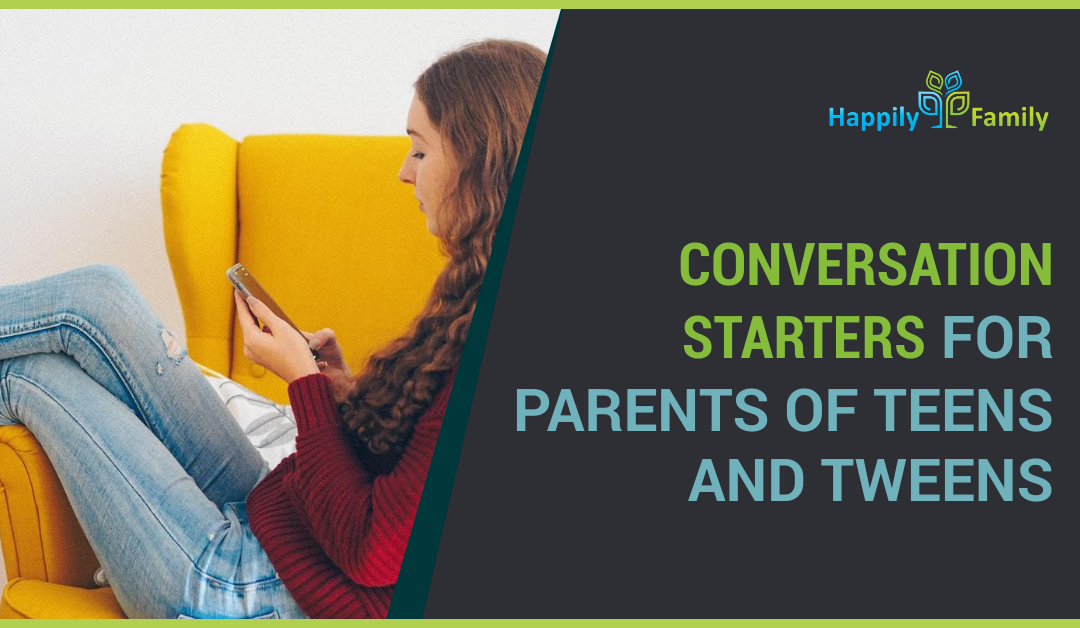
Have you ever sat next to your teenager in the car, watched them stare at their phone, and thought… “I have no idea what's going on in there anymore.”?
Or maybe family conversations have started to feel a little routine. A little surface-level. Mostly logistics… who's getting picked up when, what's for dinner, and did you do your homework?
If that sounds familiar, you're in good company.
The tween and teen years brought a quiet shift in how our kids talked to us (and how much). It can feel like the chatty, snuggly little kid you used to know has been replaced by someone who answers in single syllables or seems annoyed by a polite knock on the door. And as parents, we're left wondering how to bridge that gap.
That's where good conversation starters with teens come in.
Not as a script. Not as a way to “get information” out of them. But as a tiny doorway… a way to say, “I'm interested in who you're becoming.”
This guide will walk you through why conversations get harder during adolescence, the mindset shift that makes a real difference, and a full list of conversation starters with teens you can use tonight at dinner or tomorrow in the car. We'll also share what to do when conversation starters aren't enough on their own.
Let's dive in.
Why Conversations with Your Tween or Teen Get Harder (And Why It's Not Personal)
Before we get to the questions, it helps to understand what's actually going on. Because here's the thing… your teen pulling away isn't a sign that something has gone wrong. It's a sign that they're growing.
Knowing that might not make it easier. But maybe it will help us stop taking it personally.
What's Happening in the Teen Brain
The teenage brain is in the middle of one of the biggest renovation projects of the entire human lifespan. The limbic system (the emotional, reward-seeking part of the brain) is firing on all cylinders, while the prefrontal cortex (the part that handles planning, impulse control, and judgment) is still very much under construction.
Research from UCLA neuroscience labs shows that the brain doesn't finish this developmental period until around age 25. So when your teen seems emotionally intense one minute and totally checked out the next… that's not a character flaw. That's neurology.
This matters for our conversations because teens are processing the world in big, vivid, sometimes overwhelming ways. They need adults who can stay calm and curious while they figure out how they feel.
The Pull Toward Friends Is Developmental, Not Rejection
It can sting when your child suddenly wants to tell their best friend everything before they tell you. Or when their bedroom door starts closing more often.
And this pull toward peers is one of the most important things teens do. It's how they practice independence, build their identity, and rehearse adulthood… in a low-stakes way, before they have to do it for real.
The goal isn't to compete with their friends. The goal is to stay one of the trusted voices in their life. And that's exactly what conversation starters with teens are designed to do.
Two Things That Quietly Shut Conversations Down
Here's the sneaky one… most of us don't realize we're doing it.
When our teen finally opens up about something hard, our instinct is to fix it. Solve it. Offer advice. Maybe slip in a quick lecture about consequences or choices.
But that response (even when it comes from love) often signals to your teen, “You can't handle this on your own”.
The second thing that shuts down a conversation is if you have big feelings that come up–especially worry or anger–then your teen might have to shift into taking care of you, rather than you supporting them. In this situation, your teen ends up thinking, “I can’t tell mom anything without her freaking out. It’s easier not to tell to her.” And the conversation closes.
We talk more about this in our post on 7 ways to get kids to talk about their feelings, because the same dynamic shows up at every age… it just gets a bit louder in the teen years.
The Mindset Shift That Makes Conversation Starters with Teens Actually Work
Here's something we've learned after over two decades of working with families and interviewing leading parenting experts…
The questions matter less than the energy you bring to them.
You can have the best list of conversation starters with teens in the world, but if your teen senses that you're trying to get information, deliver a lesson, or steer them toward a “right” answer… they'll shut down. Every time.
So before you pull out a single question, try these shifts.
Check If It’s A Good Time To Talk
Sometimes teens don’t talk because they need some downtime. They’ve been “on” at school, or at practice, or in a social setting and they want to mindlessly stare at a phone or out the window for a moment to reset.
One of our kids calls this “stupid time”. It’s break from thinking and doing–often involving a screen–that serves an important purpose for nervous system regulation.
Lead with Curiosity, Not an Agenda
When you ask a question, ask it the way you'd ask a friend. With genuine interest. With no expectation of a particular answer.
Curiosity sounds like, “Hmmm, that's interesting… tell me more.” It does not sound like, “And what did you learn from that?”
If you notice yourself getting tense or reaching for a teaching moment, just pause. Take a breath. Come back to the simple goal: I want to know what their world looks like through their eyes.
Listen Way Longer Than Feels Comfortable
This is the hardest part for most of us. Teens process things slower than we sometimes expect. They might give a short answer, then go quiet, then add something deeper a full minute later… if we don't fill the silence first.
So ask the question. And when you think they're done talking, wait some more.
You'd be amazed at what comes out in that second wave of silence. Often it's the thing they actually wanted to say.
Save Your Advice for Another Day
If you have advice or a comment you really want to give, make a mental note (or jot it down later) and save it for a different conversation. Right now, your only job is to connect.
This is one of the biggest mindset shifts in our work, and one that came up over and over in our interview with a young adult (our own kid). When a teen feels like a conversation might turn into a lecture, they stop bringing things to us at all.
Make Space, Don't Force the Moment
Some of the best teen conversations happen sideways. In the car. Late at night. While you're chopping vegetables together or walking the dog. When there's no eye contact and no pressure, kids tend to talk more.
If you keep trying–and failing–to find the right moment, then we’d encourage you to ask your teen, “Is there something I could do differently that would make it easier to talk? I’d really like to hear your thoughts and feelings about things and I’m curious about how you see the world.” Then just listen to whatever they say. Chances are there will be a gem in their response.
And if you find yourself in one of those moments when emotions run high… it's so much easier to have meaningful conversations when everyone in the family knows how to regulate their feelings. We put together a free Calming Plan you can download here, and it's a beautiful tool to do as a family. Each person picks the strategies that help them most, and you have something to lean on the next time big feelings show up.
Conversation Starters with Teens: Questions Sorted by Topic
Okay. Mindset in place. Now for the actual questions.
Use 2 or 3 of these at a time, not the whole list at once (please don't pepper your teen with a ton of questions in the car, like I am known to do!). Pick the ones that fit the moment, your teen's mood, and what feels natural for your family.
Friends and Friendship
Friendships are massive during the tween and teen years. They shape identity, confidence, and even the brain itself.
- Who are your closest friends right now?
- What do you love about each of them? What's different about each friendship?
- Have your friendships changed in the past year? In what way?
- What do you look for in a really good friend?
- How do you know when someone is not your friend?
- Have you ever had to navigate a friendship that wasn't great for you? How did you handle it?
If peer pressure or tricky friendship dynamics are coming up, our post on navigating friends who feel like a bad influence goes deeper into that conversation.
School Life and Mental Health
School is where teens spend most of their waking hours, and there is so much going there, on under the surface.
- If you could change one thing about school, what would it be?
- Do you feel like the teachers at your school understand you?
- Is there an adult at school you'd go to if you needed support? What makes them approachable?
- What do you worry about most when it comes to school?
- How does your generation talk about mental health? What do you think about that?
- What helps you cope when you're feeling stressed or sad or angry?
These questions are gentle entry points into the bigger topics of family mental health and emotional well-being. You're not interrogating… you're inviting.
Family and What They Notice About Us
This category takes a little more courage, because sometimes their answers might surprise you. If the answers sting a little, stay curious.
- What do you think our family really values?
- What's a family tradition that feels really “us”?
- If you could change one thing about our family, what would it be?
- When do you feel closest to me/us?
- What's something I do that helps you… and something I do that doesn't?
That last one is brave. But it's also one of the most powerful conversation starters with teens, because it tells them that their experience of you matters.
Identity, Social Media, and the Wider World
Your teen is forming opinions about everything… gender, politics, technology, the future. They want to talk about it. They just want to feel like you'll actually listen.
- What's your favorite thing on social media right now? What do you like about it?
- Do you ever feel like social media impacts your mood? In what way?
- Are you the same person with us, with friends, at school, and online? How do you manage all those versions of you?
- What's something my generation doesn't understand about yours?
- What's something you wish more adults asked teenagers about?
- What are you most looking forward to about getting older?
The American Academy of Pediatrics has a great resource on healthy media use that pairs nicely with these conversations if you want to keep digging into the social media piece together.
When Conversation Starters with Teens Aren't Enough
Sometimes, even with the best questions and the most patient listening, your teen still seems far away. Or you notice they're struggling in ways that don't fix with a good chat in the car.
That's okay. It doesn't mean you've failed. It means parenting a teen is one of the most layered, nuanced things any of us will ever do.
Signs Your Teen Might Need More Support
Some shifts are normal adolescence. Others are signs your teen could use more than what you can offer at home. Watch for things like persistent sadness or anxiety, big changes in sleep or appetite, withdrawing from activities they used to love, or talking about hopelessness.
Mayo Clinic's overview of teen depression has helpful guidance on adolescent mental health and when to seek extra support. Trust your gut on this one. You know your teen.
How to Stay Close When They Pull Away
Even when your teen is going through something hard, your relationship is still the most protective factor in their life. Research has shown that a warm relationship with a parent is one of the strongest predictors of long-term well-being for kids and teens.
So keep showing up. Keep using gentle conversation starters with teens, even if the answers are short. Keep saying, “I love you. I'm here. I'm not going anywhere.” Sometimes that's the entire conversation. And it counts.
You Don't Have to Figure This Out Alone
Parenting was never meant to be done in isolation. That's why we built Happily Family in the first place… so parents would have a real community, ongoing expert support, and a place to ask the messy questions out loud.
If you're craving more support, we'd love to invite you to our free online parenting conference. It's a gathering of over 25 experts in connection-based parenting, and it's truly one of our favorite things we do. You can join from anywhere, on your own time.
And if you're specifically navigating the tween and teen years, we also have a dedicated track for parents of teens with experts like Dr. Daniel Siegel, Dr. Christine Carter, and others who have spent their careers studying what teens actually need. It's the kind of support every parent of an adolescent deserves to have.
Frequently Asked Questions
What are good conversation starters with teens who give one-word answers?
Start with low-stakes questions that don't require much vulnerability… things like, “What's something you saw online today that made you laugh?” or “Who's the funniest person in your friend group right now?” Avoid generic “how was your day” questions, which usually get one-word answers. The trick is to ask about something specific in their world, then stay quiet and curious. One-word answers often loosen up if we resist filling the silence and don't push for more right away.
How often should I use conversation starters with my teen?
There's no magic number. The goal isn't to schedule deep conversations every Tuesday at 7 p.m. It's to weave little moments of curiosity into your everyday life… a question on the drive to sports practice, a check-in over a snack, a thoughtful comment while you're eating a meal together. Aim for connection over consistency. One good conversation a week is a great goal, and can make a real difference, especially when your teen knows you're available without an agenda.
What if my teen refuses to talk to me at all?
First, breathe. Then ask if it’s a good time to talk. See if they just need some downtime. This is more common than you might think, and it's almost never permanent. Reassure your teen that you don’t have a hidden agenda and that they aren’t in trouble. Focus on staying present without pushing… share small things from your own day, sit near them while they game or scroll, drive them places without making it a “talk.” Your job right now is to keep the door open, not to force them through it. If the silence feels heavy or you're worried about deeper struggles like depression or anxiety, please reach out to a family therapist or your pediatrician for additional support.
A Final Note
Parenting a tween or teen is one of the most beautiful, bewildering, identity-shifting experiences out there. And it's almost never about having the perfect words.
It's about showing up. Asking gentle questions. Listening longer than feels comfortable. Trusting that your teen will figure things out and is growing exactly as they're meant to.
Print out these conversation starters with teens. Tuck them in your bag or save them on your phone. Pull them out the next time you're in the car together or sharing a meal.
And then put your phone down, soften your shoulders, and let yourself be curious about who this incredible human is becoming.