We like it when our kids do chores around the house. One of our kids is a master at cleaning the bathroom. The other one takes out the recycling, the trash, and does all the cat care. They both help with the dishes and setting the table.
But Jason and I don't pay our kids to do any of it.
We don't have a problem with giving kids an allowance. In fact, we are very “pro-allowance.”
Reading some very compelling research convinced us that paying our kids to do chores was not the right choice for our family.
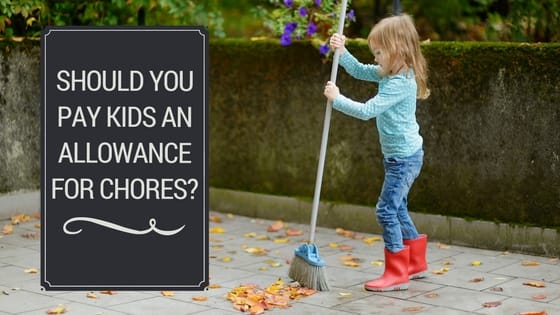
If you've ever wondered whether you should pay your kids for chores, set up a chore chart with a price tag, or hand over a dollar amount every time the dishwasher gets emptied because it would be “so much easier”, then this post is for you.
We're going to share what the science says about rewards, why tying allowance for chores together can quietly backfire, and what to do instead so your kids genuinely want to contribute to the family.
Why Offering Allowance For Chores Backfires
The idea of paying an allowance for chores feels intuitive. After all, adults work for a paycheck… so it seems like good practice for the “real world.”
But here's the thing: kids aren't tiny adults. And the research on motivation tells a very different story about what happens when we trade money for behavior.
When we link allowance for chores too tightly, we're leveraging something called “extrinsic motivation”. That's the kind of motivation that comes from outside the person (a reward, a paycheck, a sticker). It's the opposite of “intrinsic motivation”, which is the inner drive to do something because it feels good, meaningful, or worthwhile.
And it turns out… extrinsic rewards can quietly undermine the thing we're actually trying to build. This is one of the most established findings in motivation research. It's the foundation of Self-Determination Theory, developed by Edward Deci and Richard Ryan at the University of Rochester, which has been studied for over 40 years. Their work, recognized by the American Psychological Association, shows that humans are wired to seek out challenges and contribute meaningfully when we're not being controlled by external rewards.
Payment For Only Temporary Compliance
Imagine giving your child an allowance to scrub the toilet. They'd probably do it… but only as long as the money kept coming. The minute the allowance stopped, the toilet scrubbing would stop too.
That's because the behavior was never really theirs. It was rented.
Same goes for adults, honestly. Most of us wouldn't keep showing up to work if our boss stopped paying us. That's the nature of extrinsic motivation: it lasts exactly as long as the reward does.
The same is true with punishments. Your kids might scrub the toilet to avoid losing video game time. But the moment the threat is lifted, so is the behavior. Whether it's bribes or threats, you're still holding the strings… and your child is still waiting for someone else to drive the bus.
When it comes to taking care of the home they live in, and contributing to the community they are a part of, we want our children have an internally driven sense of responsibility that keeps them continuing to engage, even if there is no one there to incentivize them to.
Rewarding Chores Can Actually Be Counterproductive
Here's where it gets really interesting.
In his book Unconditional Parenting, Alfie Kohn references a study where kids who were rewarded for being “nice” to another child didn't then think of themselves as “nice” people. They were actually less likely to repeat that behavior in the future.
The reward replaced the identity. Instead of “I helped because I'm a kind person,” the child thought, “I helped because I got something for it.”
When you apply that to chores, the implications are big. Rewarding a child for doing the dishes can actually make it less likely they'll choose to do the dishes when no reward is offered. The pattern becomes: no money, no help.
That's the opposite of what most parents are hoping to teach.
Rewards Erode Intrinsic Motivation
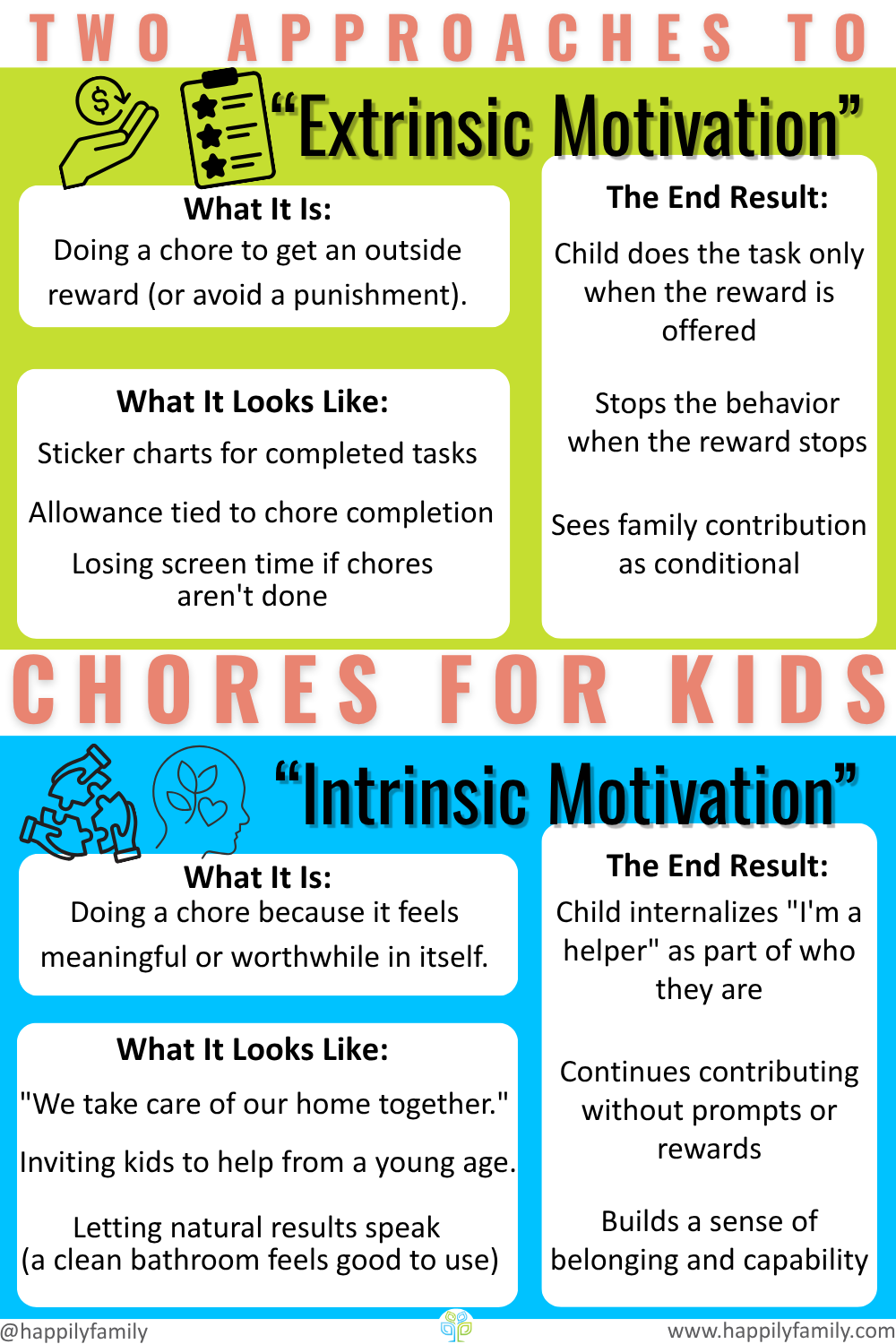
Intrinsic motivation is the inherent joy of doing something for its own sake.
I practice piano because I enjoy playing piano. I eat green veggies because they actually taste good and I like how I feel after I eat them. I'm kind to my friends because I like how it makes me feel. I scrub the toilet because it helps the family, I'm proud of how it looks, and the bathroom smells better afterward.
That last one is real. It's not glamorous, but it's true.
When we give an allowance for chores, we accidentally take that intrinsic experience away. Instead of “I'm a great helper, and I'm proud of this clean bathroom,” the child's internal narrative becomes “I'm getting paid for this.”
The meaning shifts.
The pride shrinks.
And the joy of contributing fades into a transaction.
Maybe your kids don't love scrubbing the toilet. We get it… us too. But according to Alfie Kohn's research on rewards, they will actually enjoy it more if they aren't being paid to do it.
Without payment, a child is more likely to think: “I'm a hard worker, and now it's clean. And you know what? This was actually kind of fun.”
The Real Difference Between Allowance And Chores
Here's the reframe we live by, and it's the heart of this whole post.
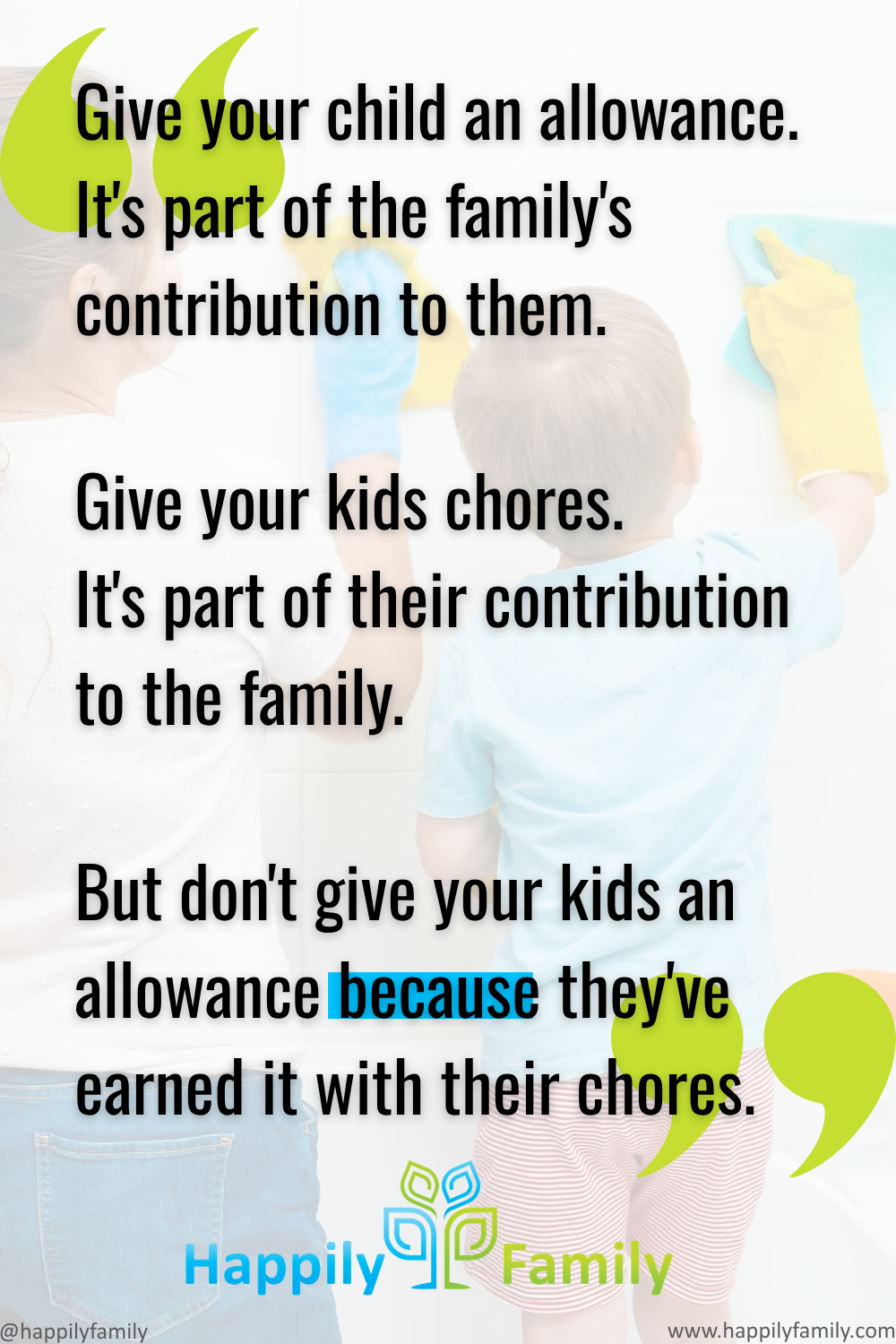
Give your child an allowance. It's part of the family's contribution to them.
And give your kids chores. It's part of their contribution to the family.
But don't give your kids an allowance BECAUSE they've earned it with their chores. Kids “earn” allowance just for being in the family, for being themselves.
Two separate things, two different lessons. For more on building motivation without bribes, our post on How to Motivate Kids Without Bribes and Threats goes deeper.
Use An Allowance To Teach Money Management Skills
If we're not using allowance for chores as a reward system, what is allowance actually for?
Money skills. That's the whole point.
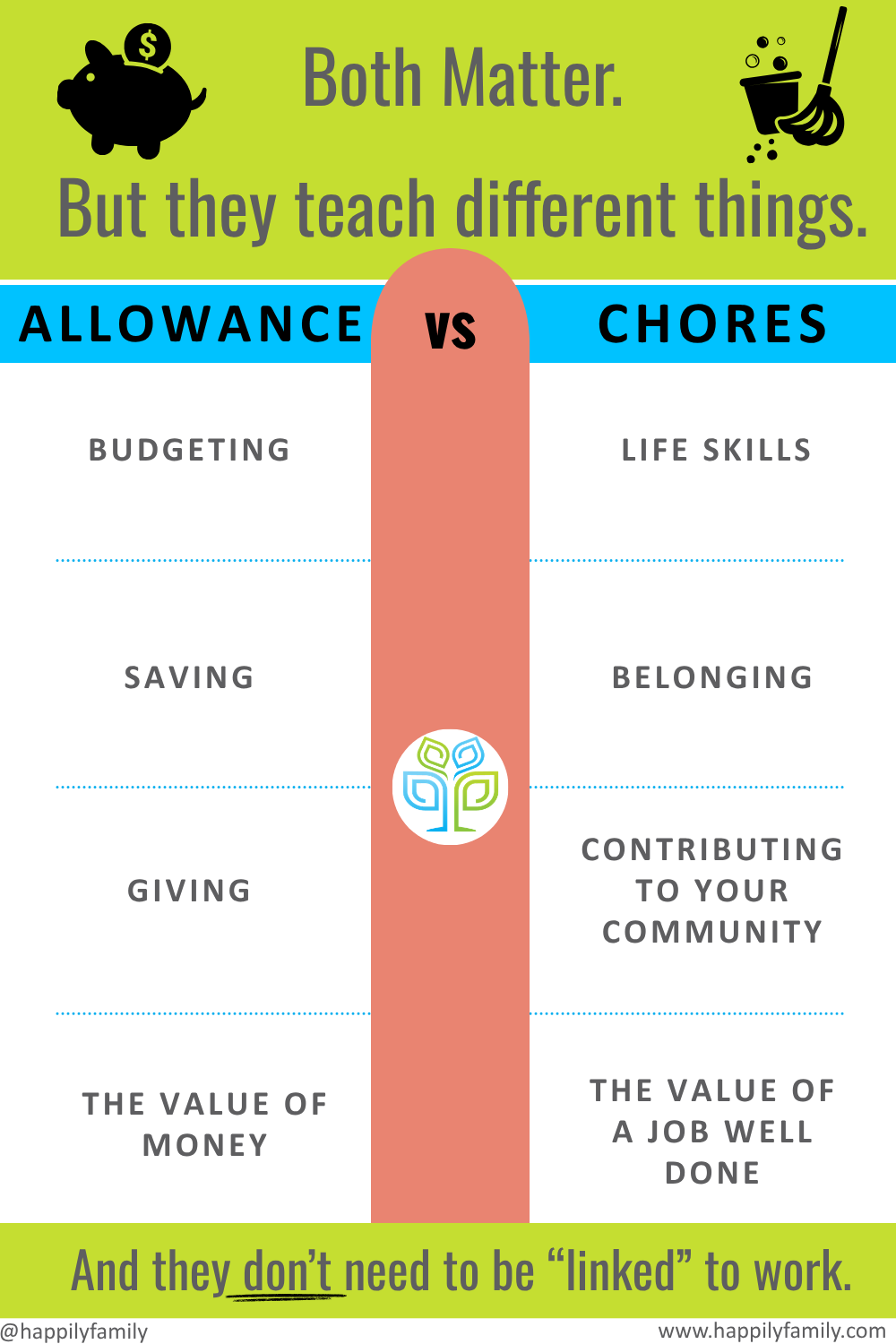
An allowance gives kids regular, hands-on practice with money management. They learn how to budget, how to save for something they really want, how to make trade-offs, and how to handle a small amount of money before they have to handle a big one.
Many families divide allowance into three categories: spending, saving, and sharing/giving. The spending money is for the things you choose not to buy them (the candy, the small toys, the extras). The saving category is for bigger goals or long-term things like college or a first car. The sharing is for charitable giving or thoughtful gifts.
This kind of system teaches financial literacy in a way that paying for individual tasks never could. Kids learn that money is a tool, not a reward for being good. According to the Consumer Financial Protection Bureau's research on youth financial education, early experiences managing money are one of the strongest predictors of healthy financial habits in adulthood.
Make Chores About Belonging, Not Earning
When kids feel like real, valued members of the family, they want to contribute. It's wired into us as humans – we want to belong.
So instead of framing chores as “your job in exchange for money,” try framing them as “this is how our family takes care of each other and our home.”
Notice the language. Chores aren't a transaction. They're a way to say, “I love this family, and I'm part of how it runs.”
This is also why some families avoid the word “chores” altogether and just call them “helping” or “family work.” Even small language shifts can change how a child relates to the task.
🌿 Free Resource: If chore time at your house often turns into nagging, frustration, or yelling, you'll love our free Family Calming Plan. It's a printable guide where every member of the family picks their own go-to calming strategies (organized by sensory, physical, and cognitive categories) so that when big feelings show up, you each have a plan for getting back to your thinking brain. Download the free Calming Plan here. 💚
What About Above-And-Beyond Chores?
This is a question we sometimes get, so let's address it directly.
Yes, our kids do regular family chores as part of contributing to the household. No allowance for those chores… they're just part of being in a family.
But what about the bigger stuff? The things you might consider paying someone outside the family to do? Painting the fence, deep cleaning the garage, washing the car, weeding the entire flowerbed?
That's where paid work can come in. Not as allowance for chores, but as a legitimate above-and-beyond opportunity to earn extra money. Think of it less like an allowance and more like contract work. The child can choose to take it on or pass.
(Fair warning: sometimes when we offer this, our kids look at the money, look at the size of the task, and say “no thanks.” That's actually fine. It's information. They're learning to weigh effort and reward, which is exactly the skill we want them building.)
This way, they get the experience of earning money for real labor, without the regular, day-to-day chores becoming a transaction.
When Allowance For Chores Feels Like It's "Working" (And Why It Still Isn't)
We hear from a lot of parents who say, “I pay my kids for chores but at least then they DO them.” And yes… they probably do.
The question is: What are they actually learning?
If your child only takes the trash out when you wave a five-dollar bill in front of them, they're learning that family contribution is conditional. They're learning that money is the reason for doing things. And they're learning that without payment, the work doesn't matter.
That's a quiet message… but a powerful one. And it can shape how they show up in friendships, schoolwork, future jobs, and adult relationships.
True responsibility comes from feeling capable, valued, and connected. Not from a paycheck.
If your kids resist doing what you ask (chores, homework, getting out the door), it might not be a motivation problem at all. It might be a connection problem. Our post on How “Giving Up” Gets Your Kids To Do What You Want explores a counterintuitive but powerful approach to this exact issue.
💚 Want to go deeper? Join us for the free Happily Family Online Conference, where we explore connection-based parenting, motivation, and how to raise kids who are responsible from the inside out. You'll hear from leading experts in child development and conscious parenting… all from your couch. Save your spot for the free conference here. 🌿
What If Your Teen Refuses To Do Chores?
The teen years bring their own flavor of chore resistance.
Suddenly the kid who used to eagerly help unload the dishwasher won't even bring their own plate to the sink. Their bedroom door is closed. They are looking at their phone. And asking them for help is likely to result in an eye roll.
This isn't because they're lazy or ungrateful. It's developmental. Teens are wired to push away from the family in order to figure out who they are. That doesn't mean we let them off the hook for contributing… but it does mean the strategy has to shift.
Connection comes first. Conversation and collaboration are second. Chores third.
🌿If you're navigating this with your teen, our free Parent Teen Connection Conference is built specifically for parents of tweens and teens. It covers communication, connection, motivation, and so much more, with experts who specialize in the adolescent years. Register for the free Teen Conference here. 💚
A Final Word
Tying allowance for chores together feels normal in our culture… but normal isn't always best.
When we separate allowance from chores, we give our kids two beautiful gifts: the chance to develop real money management skills, and the chance to feel like a genuine, valued, contributing member of the family. Both of those will serve them long after they've moved out of your house.
It's not about getting the system perfect. It's about staying connected to the why.
Give your child an allowance. Give them chores. Let them know they belong here, and that this family runs on love, contribution, and yes… a clean bathroom every now and then.
Common Questions From Parents Like You
Should I pay my child an allowance for chores or not?
Most research on motivation suggests that tying allowance for chores together isn't the most effective way to teach either responsibility or money management. Kids do best when allowance is given as a tool for learning to budget, save, and give… while chores are framed as a way of contributing to the family. Keeping the two separate helps build intrinsic motivation, which lasts long after the rewards stop.
How much allowance should I give my child if it's not tied to chores?
There's no universal rule, but a common guideline is $1 per week per year of age. A5-year-old might receive $5 a week, and a 10-year-old $10. As kids get older, you can also give them more responsibility for their own expenses (clothes, outings, gifts) so the allowance becomes a more meaningful budgeting tool. The “right” amount depends on your family's values and finances, not a rigid formula.
What if my child refuses to do chores without being paid?
This is very common, especially if a reward system has been in place for a while. The shift takes time. If you’d like your child to do the dishes, start by having a conversation with your child outside of dish time. Ask questions to understand their perspective about why they don’t want to do dishes, and empathize with their answers. “That makes sense to me”. Ask your child if they have any ideas about how to get the dishes done. If they don’t like getting their hands dirty, give them rubber gloves. If they don’t like dishes but don’t mind sweeping, let them swap tasks. If dishes just aren’t fun, offer to make it into a game, do dishes together, choose the music, or talk about what fun thing they will do after they are done, and how good it feels to complete a task. .
For families ready to break the bribes-and-threats cycle entirely, our Family Calming Plan is a great starting point for building the emotional regulation that makes connection-based parenting actually possible.