Have you been spending more days than you would like just trying to survive until bedtime?
Modern parenting can feel like running a marathon without a water station in sight.
We're expected to be the teacher, chef, therapist, entertainer, chauffeur, and coach …usually all before breakfast.
And most of us can admit that while we might be a natural at some of those roles, others are just not within our skill set. Typically, this leaves us feeling overwhelmed and underresourced at the best of times–and straight up burnt out at the worst.
And yet, you are here, using your spare few minutes to read a parenting blog, so I know you are doing your best to give your kids everything they need to thrive in life, and it probably feels like it’s still not enough.
I’m gonna let you in on a little secret: That was never meant to be your responsibility. At least, not all on your own.
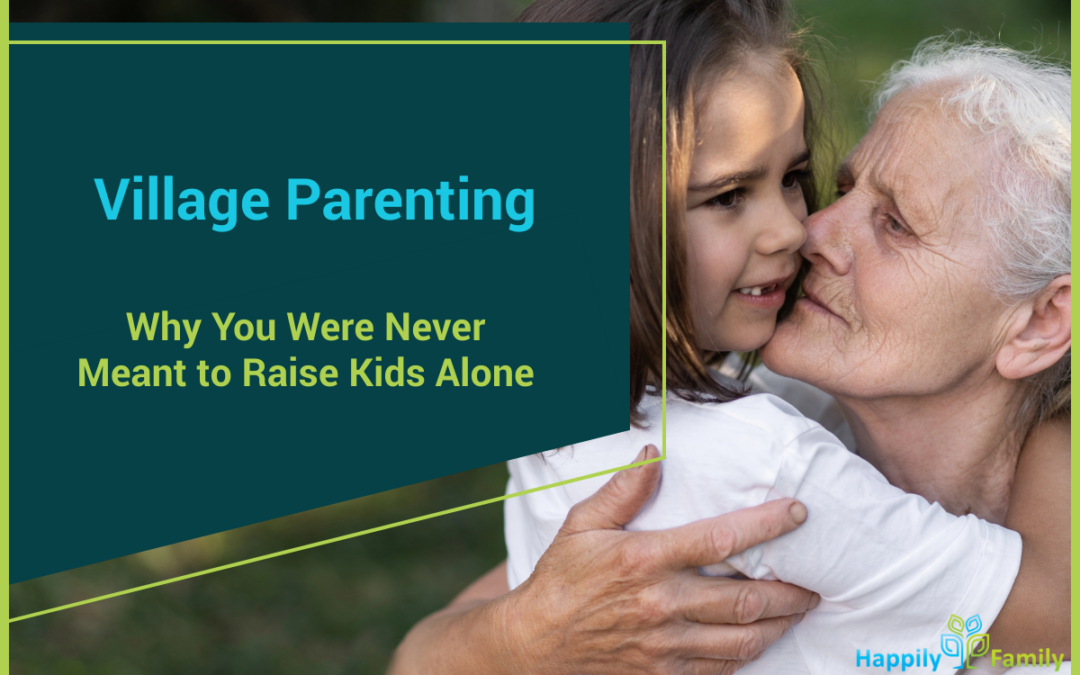
Village parenting isn't just a nice idea from simpler times. It's actually how humans have evolved to raise children over thousands of years.
“It takes a village to raise a child” is such a well-known phrase for a reason.
Healthy, “biologically normal” parenting was always meant to be done by a whole group of adults – not just one or two.
What Is Village Parenting?
Village parenting is the practice of raising children within a community of caring adults, not just parents. It means grandparents, aunts, uncles, neighbors, teachers, coaches, and friends all play meaningful roles in a child's life.
Scientists call this “alloparenting.” The term comes from biology and describes caring for young by individuals who aren't the biological parents. This isn't some trendy parenting hack.
Alloparenting is universal across all human cultures and has shaped us through evolution.
In her New York Times bestselling book Hunt, Gather, Parent, NPR correspondent Michaeleen Doucleff traveled to Maya villages in Mexico, Inuit communities in the Arctic, and Hadzabe families in Tanzania. What she discovered was striking: these communities don't have the same struggles with children that Western parents do.
Why? In large part because they practice village parenting naturally.
Doucleff observed how Hadzabe children benefit from a network of caregivers beyond their parents, including older siblings, other children, and community members. This aligns with broader research showing that social support networks promote well-being for both children and parents. Studies published in Scientific Reports have found that mothers with strong social support are significantly less likely to experience postpartum depression, while neurobiology research suggests that early exposure to multiple caregivers may serve as a protective factor against later mental health challenges.
The Hidden Cost of Raising Kids Without a Village
Psychiatrist Bruce Perry puts it powerfully: “At no other time in the history of humankind have we left only one or two adults to meet the physical, social, emotional, and spiritual needs of one or more children.”
Think about that for a moment.
We're doing something that has never been done before in human history: trying to meet every need of our children with just one or two people. It’s no wonder so many of us feel exhausted, overwhelmed, and burned out.
Research published in BMC Public Health confirms what many parents feel in their bones: parental burnout is significantly higher in countries that value individualism over collectivism. Social support acts as a powerful protective factor against parental burnout.
When we try to parent in isolation, we're working against our biology. Our brains are literally wired for connection and community support.
Why Modern Parents Feel So Exhausted
If you find yourself constantly depleted, it's not because you're doing something wrong. It's because you're trying to do something that's nearly impossible: be everything to your child all by yourself.
Village parenting acknowledges the simple truth that children thrive when they experience love, resources, and learning from many different hands, and parents do too.
Dr. Daniel Siegel, clinical professor of psychiatry at UCLA and a frequent speaker at our Happily Family conferences, explains that “attachment is not just about one relationship.”
He emphasizes that while it is true that a child needs to have a secure attachment with at least one caregiver to reap the benefits of secure attachment, children can develop secure attachment through their entire social ecosystem (fathers, grandparents, extended family members, caregivers, teachers, and community members). All of these separate, unique attachments bolster and fortify a child’s resiliency and well-being.
Why Building a Village Feels So Hard (And Why It's Not Your Fault)
If you're reading this thinking, “That sounds great, but I don't have a village,” please hear this: You have done nothing wrong.
The reality is that modern life has made village parenting incredibly difficult, and that's not because of anything you did or didn't do. It's because the world has changed in ways that work against the very connections we need most.
We Live Far From Family
Many of us live hundreds or thousands of miles from the people who would traditionally help raise our children. We moved for jobs, for education, for opportunity, or simply because life took us somewhere new.
There's no village waiting when you relocate for work. There are no grandparents down the street when your career takes you across the country.
Economic Pressures Leave No Time or Energy
For many families, survival requires every adult to work, sometimes multiple jobs. When you're spending all your time just trying to keep the bills paid and food on the table, there's nothing left for building community.
This isn't a personal failing. It's a systemic reality that makes connection feel like a luxury rather than the necessity it truly is.
Some of Us Had to Leave Our "Village" Behind
Here's something that doesn't get said enough: Sometimes the healthiest thing you can do is walk away from toxic relationships (even with family).
If your family of origin was abusive, neglectful, or harmful to your well-being, choosing distance isn't a failure to maintain your village. It's a profound act of love and protection for you and your children.
Leaving behind or limiting unhealthy relationships with partners, family, friends, or community is just as important as fostering healthy ones.
If you've created boundaries with toxic family members, left a harmful religious community, or distanced yourself from friendships that were draining rather than sustaining, you have not lost your chance at a village, nor have you set yourself up for parenting failure.
Our Culture Tells Us We Should Do It Alone
On top of everything else, we live in a society that glorifies independence and self-sufficiency. We're told that needing help is weakness. That “good” parents handle everything themselves.
This message is everywhere, and it's wrong.
The truth is, asking for help isn't a sign that you're failing. It's a sign that you understand what humans have always known: we were designed to raise children together.
You're Starting From Where You Are
Whatever your situation, whether you're isolated by geography, economics, past trauma, or you were just holding yourself to an unrealistic standard, you haven’t failed. You're navigating a world that has made natural human connection extraordinarily difficult.
There is a pathway to “village parenting” that you can take. And it’s not as impossible as it might seem. You can build something new, one small connection at a time, with people who are safe and trustworthy.
And that's exactly what we'll explore next.
How to Build Your Village Parenting Network
The good news? You don't need an actual village. According to Doucleff's research, you really just need a few trusted adults who care about your child and share your values.
Anthropologist Suzanne Gaskins calls this “the auntie network.” Teaming up with two or three other families to share childcare, pickups, weekend hosting, and emotional support. These families become the aunts, uncles, and cousins your child needs.
Start Small and Simple
Village parenting doesn't have to be complicated or overwhelming. Start by asking yourself: What's one small thing I could use help with?
Maybe it's transportation to activities. Perhaps it's help with homework or childcare for just an hour or two. Start with whatever feels manageable.
Then Ask for Help
Asking for help can feel scary. We might worry about being a burden or seeming like we can't handle things.
But here's what I've learned: humans are natural helpers. People genuinely love to help. Think about how good it feels when someone asks for your help.
The good news is that the more you practice this, the easier it becomes. So take the first step and send the text message or make the call.
Look Around—Your Village Might Already Exist
Who does your child already have a connection with? Who has offered to help before? Who shares your values about raising kids?
Think about family friends, coaches, moms you have talked to at drop off, or anyone else in your local community. Is there someone that you just seem to “click” with? Maybe your child has already built a rapport with their friend’s parents , and you seem to share similar values?
Help Your Child Initiate Connections
If your child is passionate about a particular topic, help them connect with adults who share that interest. You can reach out yourself, or assist your child in making that connection through a phone call, text, or email.
Organizations and clubs can also be wonderful sources of caring adults. Whatever your child loves—science, sports, art, music, hobbies—there are groups where they can connect with mentors and supportive community members.
Village Parenting in Action: A Real Story
Recently, one of our kids was going through a rough patch with a challenge that Jason and I had no experience with. In our child's eyes, we had no credibility on this topic.
We knew it was time for an alloparent.
I thought of a 70-year-old man from my music class who had faced the exact same challenge growing up. I reached out, we talked, and I invited him to dinner.
While I cooked, he talked with our child in the living room. I don't know exactly what was said, but I know it helped our child feel less alone. Now our child has another support person who truly understands what they're going through.
That's village parenting. It doesn't require a formal arrangement or a massive network. Sometimes it's just one caring adult who shows up at the right time.
The Science Behind Why Village Parenting Works
Dr. Daniel Siegel's research at UCLA shows that what matters most is that children have consistent, responsive relationships with adults who see and value them. When a child experiences this kind of connection from various caring adults, they develop a fundamental sense of being safe and supported.
According to research from the Greater Good Science Center, cultivating your village is one of the most effective ways to prevent and recover from parental burnout.
Village parenting benefits everyone. Children get to learn from many different people and receive love in diverse ways. They learn to adapt, trust widely, and form secure attachments that serve them throughout their lives.
And parents? We get to breathe. We get to be human. We get to parent from a place of support rather than depletion.
Want to dive deeper into the research on connection and attachment? Our Happily Family Online Conference features experts like Dr. Daniel Siegel sharing practical strategies for building stronger family relationships.
You Weren't Meant to Do This Alone
Village parenting isn't about admitting defeat or being inadequate. It's about embracing the way humans have successfully raised children for millennia.
Building your village takes time and intentionality, but even small connections can make a profound difference. One trusted neighbor. A grandparent who calls weekly. A friend's parent who genuinely cares.
These relationships matter for your children and for you.
You don't have to parent alone. And you were never meant to.
Frequently Asked Questions About Village Parenting
Why am I so tired around my kids?
Feeling exhausted around your kids is incredibly common—and it's not your fault. Research shows that parenting in isolation, without adequate social support, significantly increases the risk of burnout. Our modern culture often expects one or two adults to meet all of a child's physical, emotional, social, and spiritual needs—something that has never been the norm throughout human history. Building a support network through village parenting can help restore your energy and resilience.
What is a village in parenting?
A “village” in parenting refers to the network of caring adults who help raise a child beyond just the parents. This can include grandparents, extended family, neighbors, teachers, coaches, family friends, and community members. Village parenting recognizes that children thrive when they have consistent, responsive relationships with multiple adults who care about them. It's based on the concept of alloparenting—the biological term for caring for young by non-parents—which is universal across all human cultures, and some animal species too.
Is it possible to raise kids without a village?
While it's technically possible to raise children without a village, research suggests it comes at a high cost to both parent and child well-being. Parents who lack social support are more vulnerable to burnout, exhaustion, and emotional depletion. Children benefit enormously from having multiple caring adults in their lives. The good news is that you don't need a literal village; even two or three trusted families or individuals who share your values can provide meaningful support. Building your village starts with small steps: asking for help, connecting with other parents, and allowing your children to form relationships with other caring adults.
What experiences have you had with village parenting? When has your child been supported by an alloparent? Share your story in the comments below.